


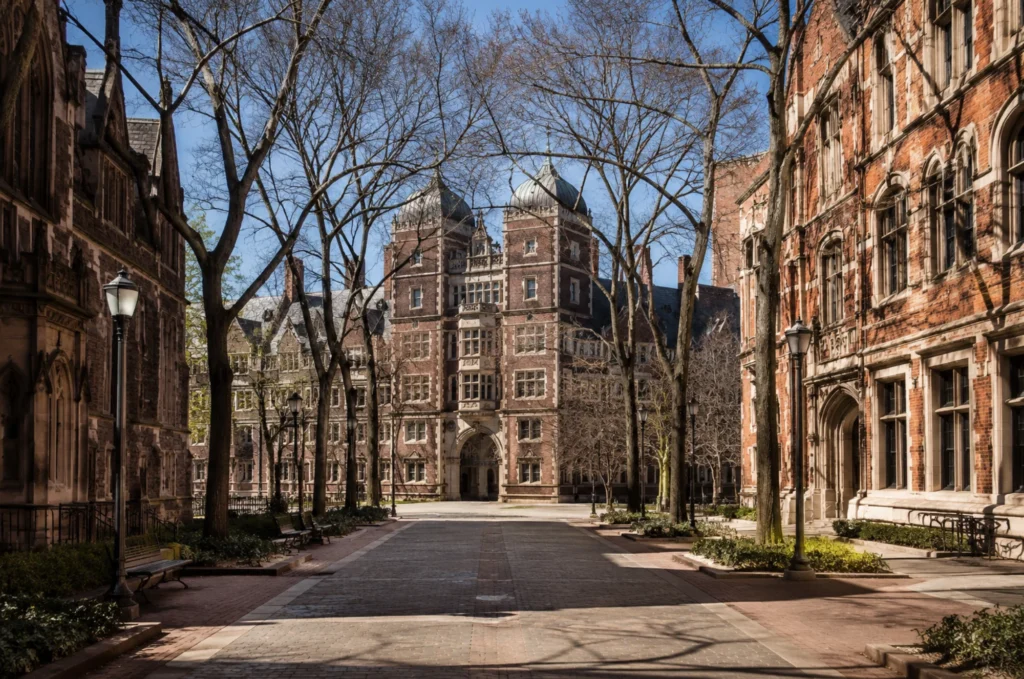
The University of Pennsylvania admits fewer than 5% of applicants each year, making it one of the most selective top private colleges in America. That figure places Penn among the colleges with the lowest acceptance rates in the country.
Understanding how to get into UPenn starts with knowing the full university requirements: academic benchmarks, application components, and essay requirements. It also includes a holistic review that goes beyond grades and test scores.
Penn evaluates each application across multiple dimensions, and no single factor guarantees admission or disqualifies a candidate. This guide explains the University of Pennsylvania’s admission requirements to help students and families understand the university application process and set clear expectations.
Table of Contents
ToggleKey Takeaways
- Penn’s acceptance rate has dropped below 5%, with the Class of 2029 sitting at 4.87%, making it one of the most selective universities in the country.
- Admitted students average a 3.9 GPA, and the middle 50% of SAT scores range from 1500 to 1570. Still, Penn reviews all academic credentials in the context of each school’s grading scale and course availability.
- Applicants choose one of four undergraduate schools – College of Arts and Sciences, Wharton, Engineering, or Nursing – and each requires a school-specific essay that goes beyond general interest in Penn.
- Early Decision is binding and due November 1; students who apply ED and are admitted must withdraw all other applications and commit to enrolling.
- Penn meets 100% of demonstrated financial need with no merit scholarships, and the estimated total cost of attendance for 2024-25 was approximately $95,612 before aid.
How Hard Is It to Get into UPenn?
Penn’s acceptance rate has declined every year for the past decade. The school received over 65,000 applications for the Class of 2029 and admitted fewer than 5% of them. ED applicants historically see higher rates than the overall pool, though Penn does not publish a separate ED figure.
Applying Early Decision is a binding commitment – you, your parent or guardian, and your school counselor all sign an agreement to enroll if admitted. For a well-prepared applicant, Penn is their first choice; it is a reasonable strategic consideration, not a shortcut.
UPenn Acceptance Rate by Year
- Class of 2026: 6.50%
- Class of 2027: 5.87%
- Class of 2028: 5.40%
- Class of 2029: 4.87%
Each cycle, the applicant pool grows while the number of available spots remains roughly fixed. Fewer than 2,400 students enroll in a typical incoming class, and Penn’s numbers track closely with other highly selective Ivy League schools.
What GPA and Test Scores Do You Need for UPenn?
Penn does not publish minimum cutoffs, but data from admitted classes makes the competitive range clear. The average GPA for the Class of 2028 was 3.9. Also, 92% of ranked students graduated in the top 10% of their class. Penn reviews GPA in context, accounting for your school’s grading scale and course rigor.
A 3.7 falls below the admitted student average and puts more pressure on the rest of the application, though an upward grade trend over junior and senior years helps.
Penn requires standardized tests for the 2025-26 cycle. Middle 50% ranges for the Class of 2028:
- SAT Total: 1500-1570 (Median: 1540)
- ACT: 34-35 (Median: 35)
A 1500 SAT sits at the bottom of the middle 50% range and is more viable when the rest of the application is genuinely strong. Penn superscores both tests.
Course rigor also matters. 98% of admitted students graduated in the top 25% of their class. AP, IB, or honors courses in all five core subjects show readiness for Penn’s curriculum.
UPenn Requirements for Admission: The Full Application Checklist
The UPenn admission requirements span several components. Penn accepts both the Common App and the Coalition Application, treating both equally. The Penn application fee is $75, with fee waivers available through either platform for students facing financial hardship.
Penn requires SAT or ACT scores for first-year applicants. Self-reported scores are accepted at submission, but official scores are required for admission.
The testing agency must send official scores directly to us. Letters of recommendation required:
- One from a school counselor
- One from a teacher in a core subject area
- One optional letter from a second teacher or non-academic supporter
UPenn Application Deadlines 2026
- Early Decision: November 1
- Regular Decision: January 5
- Financial Aid – Early Decision: November 6
- Financial Aid – Regular Decision: February 1
- Mid-Year Report: February 15 for deferred Early Decision applicants
Missing a financial aid deadline can affect your award even after you are admitted.
UPenn Supplemental Essays
Penn requires three supplemental responses in addition to the personal statement from the Common Application or Coalition Application. Two apply to all first-year applicants. The third is school-specific.
The thank-you note prompt asks applicants to write a short 150-200 word experience about someone they have not yet thanked. Penn encourages applicants to share this note with that person, if possible, and to reflect on the experience afterward. Specific, genuine responses outperform performative ones.
The community prompt asks applicants to explain how they will explore community at Penn, consider how Penn will help shape their perspective, and how their perspective will help shape Penn, in 150-200 words.
The strongest answers name specific programs, courses, or research opportunities rather than offering generic praise. Each undergraduate school also has its own prompt. Some specialized degree programs also need extra responses beyond the standard one.
What Does UPenn Look For in Applicants?
Understanding what UPenn looks for means moving past the numbers. Penn’s admissions committee conducts a holistic review and evaluates academics, essays, recommendations, and activities together, much like what most Ivy League schools look for in applicants.
Depth matters more than breadth in extracurriculars: a student who has committed seriously to one area and built something real stands out over one with surface-level involvement across a dozen activities.
The Class of 2028 included 2,396 students from over 65,000 applicants. 15% came from outside the United States, 21% were Pell Grant eligible, 19% were first-generation college students, and 23% were historically underrepresented minorities.
Penn builds its class intentionally, and background and perspective factor into the final decision alongside academic performance.

UPenn’s Four Undergraduate Schools
At the University of Pennsylvania, applicants apply to a specific school, not to the university as a whole. The College of Arts and Sciences is Penn’s largest undergraduate school. It offers over 90 majors and a sector-based curriculum. This suits students who want structure and flexibility.
Wharton is one of the most selective undergraduate business programs in the country. The Wharton essay asks you to link your interest in business to specific resources. Proven experience also helps your application. Internships or entrepreneurial projects can strengthen it.
Penn Engineering covers computer science, electrical engineering, bioengineering, and related fields, with strong performance in math and science expected. Penn Nursing ranks among the top programs in the country. Applicants should show interest in health and patient care. Do this through clinical experience or healthcare shadowing.
Early Decision, Deferrals, and the Waitlist
The Early Decision deadline is November 1. Applying ED means entering a binding agreement: if admitted, you withdraw all other applications and commit to enrolling. Apply ED only if Penn is a clear first choice.
A deferral moves your application into the Regular Decision pool. Submit a mid-year report and, if appropriate, a brief letter of continued interest that adds something new. Penn waitlisted 2,958 students for fall 2024 and admitted just 66 of them. Students who accept a waitlist spot should have confirmed enrollment elsewhere.
Financial Aid at UPenn
Penn meets 100% of demonstrated financial need. Aid is entirely need-based, with no merit scholarships. Aid eligibility is calculated using the FAFSA, CSS Profile, and federal tax returns.
The estimated total cost of attendance for 2024-25 was about $95,612 for on-campus students. It included tuition ($63,204), fees ($8,032), housing, food, books, and personal expenses. For students who qualify, the actual cost is often substantially lower.
Frequently Asked Questions About UPenn Admissions
- Does UPenn require interviews? As of the 2025-26 cycle, Penn no longer offers interviews. Past alum conversations were informational only.
- Is UPenn a state school? No. Penn is a private Ivy League University, separate from Pennsylvania State University.
- Does UPenn superscore? Yes. Penn superscores both the SAT and ACT.
- Can you apply to more than one Penn school? No. Each applicant selects one specific undergraduate school when they apply to Penn.
CollegeCommit gives data-based guidance from an Ivy League admissions consultant, covering application timelines and academic goals.
The platform works entirely online, giving students access to structured support regardless of location.
Related Articles


