

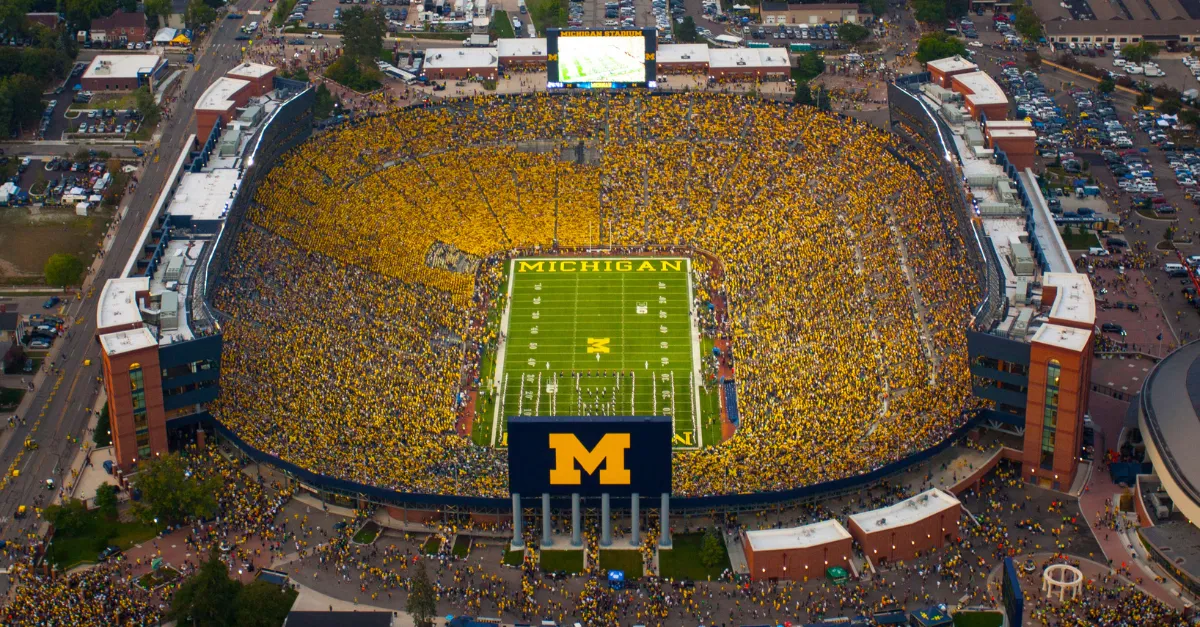
College football venues vary widely in size, but the biggest in the United States are defined by official seating capacity. Michigan Stadium leads the list with more than 107,000 seats, followed closely by Beaver Stadium at Penn State and Ohio Stadium at Ohio State, each exceeding 100,000 seats.
These examples illustrate that the largest college football stadiums are ranked by fixed-seat capacity rather than by single-game attendance or historical attendance records.
Most of these stadiums belong to long-established programs in conferences like the Big Ten and SEC, where sustained demand has driven gradual expansion over decades.
This article explains how capacity is measured, why certain stadiums remain at the top, and how rankings change over time.
Key Takeaways
- College football stadium size is determined by official seating capacity, rather than by single-game crowds or attendance records, thereby enabling consistent and fair comparisons across venues.
- The largest college football stadiums are concentrated in the United States, especially within the Big Ten and SEC, where long-term demand and incremental expansions have shaped massive venues.
- Rankings often change due to renovations, safety upgrades, or accessibility improvements, even when a stadium’s overall footprint remains the same.
- College stadiums frequently exceed professional football venues in size because they prioritize seating volume over premium amenities and revenue-focused design.
- Claims about extremely large capacities, such as 200,000 seats, usually involve non-football venues or temporary setups and do not reflect permanent stadium infrastructure.
What Is the Largest College Football Stadium?
The largest college football stadium by seating size is Michigan Stadium, with over 107,000 seats, located in Ann Arbor. It is widely known as the Big House and has held the top spot for many years. Its scale is based on permanent seating, not temporary additions or standing areas. This distinction is important because it sets a consistent standard for comparison across venues.
College Football Stadiums by Capacity
How capacity is measured
Stadium size is determined by official capacity, defined as the number of fixed seats approved for use during games. These figures are published by universities and athletic departments and updated after major renovations. NCAA football stadium capacities are constrained by safety standards, structural limits, and long-term seating layouts. This method allows rankings to remain consistent even when crowd sizes vary from week to week.
Capacity vs attendance
Capacity is often conflated with attendance records, but the two are distinct. Attendance may exceed seating capacity when temporary seating or standing room is permitted. In contrast, capacity remains a fixed number tied to infrastructure. This difference explains why a stadium may report attendance higher than its listed capacity without changing its ranking.
Largest College Football Stadiums in the United States
Many of the largest college football stadiums are located in the Midwest and Southeast. These venues host programs with long histories and large regional followings. College football stadiums in these regions are designed to accommodate regular crowds well above 80,000. Size alone does not reflect success, but it does shape game-day experience, logistics, and long-term planning.
Top 10 Biggest College Football Stadiums
Below is a clear, capacity-based list of the ten largest college football stadiums in the United States, ranked by official seating totals. Capacities are approximate and reflect permanent seating, not single-game attendance.
- Michigan Stadium (University of Michigan) – 107,601 seats
- Beaver Stadium (Penn State University) – 106,572 seats
- Ohio Stadium (Ohio State University) – 102,780 seats
- Kyle Field (Texas A&M University) – 102,733 seats
- Tiger Stadium (Louisiana State University) – 102,321 seats
- Neyland Stadium (University of Tennessee) – 101,915 seats
- Darrell K Royal-Texas Memorial Stadium (University of Texas) ≈ 100,119 seats
- Bryant–Denny Stadium (University of Alabama) ≈ 100,077 seats
- Sanford Stadium (University of Georgia) ≈ 92,746 seats
- Rose Bowl (UCLA) ≈ 91,000 seats (approximate listed seating, not official FBS) — ⚠️ URL missing in source: please add the correct UCLA Athletics or Rose Bowl link here
Note: Capacities may vary slightly due to renovations or seating reconfigurations, but these figures reflect the most current available data as of 2025–26.
These stadiums are designed for long-term use by a football team across full seasons, with layouts that prioritize fixed seating and safe crowd flow rather than temporary capacity increases.
Top 20 Biggest College Football Stadiums
Just outside the top ten are several stadiums that still rank among the largest in the country, generally holding between 75,000 and 90,000 fans. These venues often reached their current size through phased renovations, allowing programs to expand seating while preserving historic layouts and on-campus locations.
Examples with seating capacities over 80,000 include:
- Hill Griffin Stadium (Florida) ≈ 88,500 seats
- Jordan-Hare Stadium (Auburn) ≈ 88,000 seats
- Memorial Stadium (Nebraska) ≈ 85,400 seats
- Gaylord Family Oklahoma Memorial Stadium (Oklahoma) ≈ 83,500 seats
- Clemson Memorial Stadium (Clemson) ≈ 81,500 seats
Differences in seating design reflect regional demand, renovation timelines, and whether a stadium also hosts non-college events, all of which influence its final size.
Top 50 biggest college football stadiums
The broader list includes stadiums that host major bowl games and long-standing conference matchups. Some venues on this list are also used for non-college events, which influences their design. Even within the top 50, seating layouts vary widely. Differences reflect geography, climate, and local demand.
Largest NCAA Football Stadiums
The largest NCAA football stadiums typically have seating capacities exceeding 100,000. These venues require extensive planning for crowd flow, transportation, and safety. Their size results from decades of incremental growth rather than from single expansion projects. As a group, they represent the upper limit of college venue design.
Largest stadiums by conference
Conference alignment also influences stadium size. The Big Ten and SEC account for most top-capacity stadiums. Other conferences tend to prioritize modern amenities over raw seating totals. This distribution reflects differences in regional demand and funding models.
Biggest Football Stadiums Worldwide
Looking beyond college football places these venues in a global context and highlights their relative size by international standards. The largest football stadium in the world is Rungrado 1st of May Stadium in North Korea, which has an official capacity of roughly 114,000 seats and is used for football matches and national events.
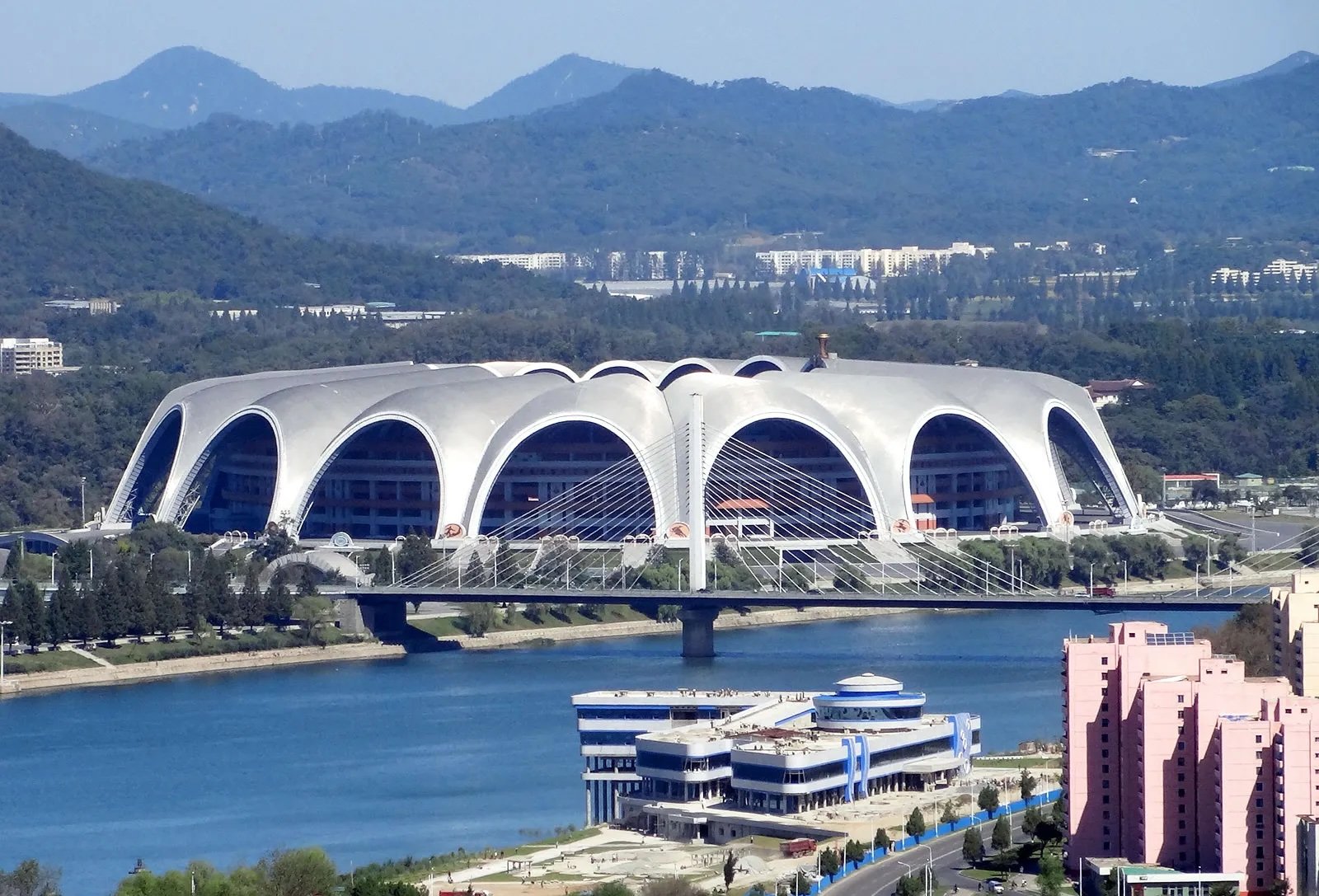
Other major global venues include Camp Nou in Spain at about 99,000 seats, Wembley Stadium in England with around 90,000 seats, and Estadio Azteca in Mexico at roughly 87,000 seats.
While several U.S. college stadiums would rank among the largest stadiums worldwide, most international venues of this size are operated by national teams or professional clubs rather than universities. This comparison underscores how unusual it is for U.S. college programs to maintain stadiums that rival or exceed many professional and international football facilities.
Largest NFL Stadium vs College Stadiums
The largest NFL stadium by official seating capacity is MetLife Stadium in New Jersey, which holds about 82,500 fans for professional football games.
This difference exists because NFL stadiums are designed to maximize premium seating, suites, and year-round revenue rather than raw capacity. College stadiums, especially those built decades ago, often prioritize fixed seating volume to accommodate large student and alumni crowds, which is why they dominate overall capacity rankings.
Frequently Asked Questions
Is there a football stadium that can hold 200,000 people?
No football stadium with permanent seats is that large. Claims of 200,000 seats usually refer to temporary seating, standing areas, or venues not built for football. Safety rules and building limits keep stadium size well below that number.
Why do college football stadium rankings change over time?
Rankings change when schools renovate their stadiums. Some updates add seats, while others remove seats to improve safety or access. A stadium can move up or down the list without being rebuilt.
Does attendance equal stadium capacity?
No. Attendance may exceed capacity during special events. Capacity counts only fixed seats and is the number used for rankings.
How do bowl and neutral-site stadiums affect rankings?
Some large stadiums host bowl games or neutral-site matchups and are not home to one team. They may appear in rankings even if no school uses them every week. This is why lists can include venues that are not on a college campus.
Near the end of the research process, we at CollegeCommit often observe how athletic environments intersect with broader campus considerations, alongside academics, admissions pathways, and student life at top public universities. These environments also reflect how athletic leadership, including college coaches, can shape campus culture and visibility. Understanding such facilities supports informed evaluation when comparing universities, including options among the best colleges for undecided majors, within a structured college-planning process.
