



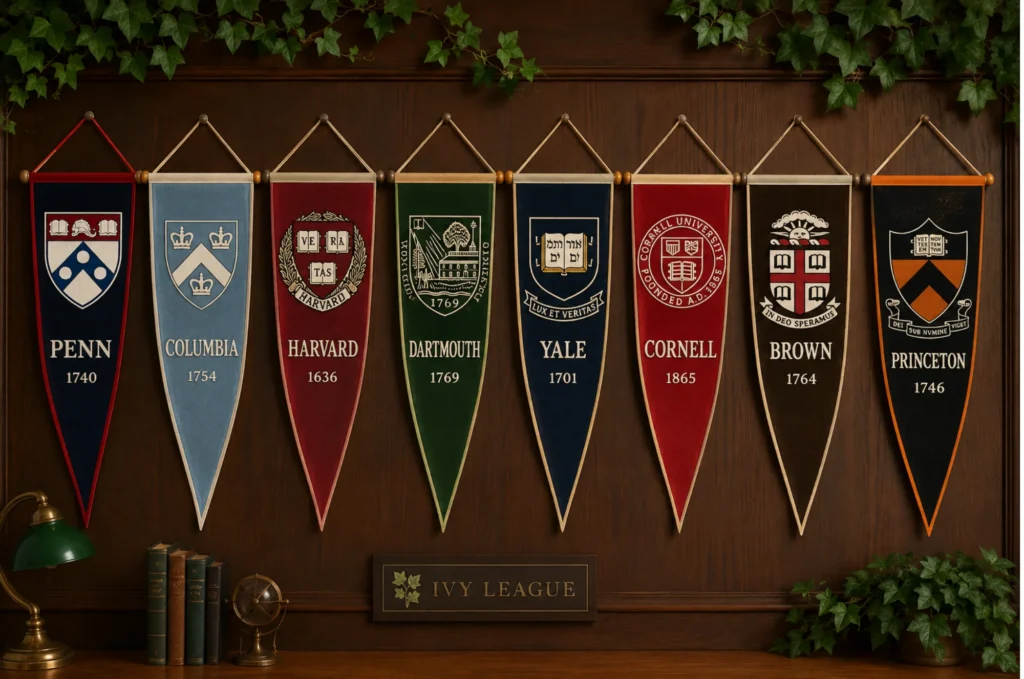
People call the annual day when all eight Ivy League schools release regular admissions results Ivy League decision day. For the Class of 2030, this date was Thursday, March 26, 2026, with most results posted at 7:00 p.m. Eastern Time.
Brown, Columbia, Cornell, Dartmouth, Harvard, Princeton, Penn, and Yale coordinate the release. This helps ensure no school gains an enrollment edge over another. This guide explains the timing, the school-by-school release process, and what to do after schools release decisions.
Table of Contents
ToggleKey Takeaways
- Ivy Day 2026 fell on Thursday, March 26, with most Ivy League schools releasing Regular Decision results at 7:00 p.m. Eastern Time. A few schools posted as early as 5:00 p.m. ET through their applicant portals.
- The coordinated release applies only to Regular Decision applicants. Early Decision, Early Action, and Restrictive Early Action results come out in mid-December, separate from the March window.
- Class of 2030 acceptance rates hit record lows, with Columbia at 4.23 percent, Yale at 4.24 percent, Brown at 5.35 percent, and Cornell at nearly 7 percent. Harvard, Princeton, Penn, and Dartmouth withheld official figures.
- Applicants should confirm portal login credentials in advance, plan a quiet space for the release, and step away from social media if it adds pressure. A decision reflects institutional priorities, not personal worth.
- Waitlisted students should still commit to a school that accepted them by May 1, since waitlist movement is slow and unpredictable. Appeals after a denial are rarely successful and are only considered for administrative errors.
When Is Ivy League Decision Day 2026
Exact Date and Time Ivy Day Decisions Come Out
Ivy Day 2026 fell on Thursday, March 26, with results posted between 5:00 and 7:00 p.m. Eastern Time, depending on the school. Most Ivies released their decisions at 7:00 p.m. ET. Applicants on the West Coast received results in the late afternoon, while international applicants checked portals overnight in their local time zones.
The release time has stayed consistent for several admissions cycles. Schools usually send an email confirming when the portal will go live, but the actual decision is only visible after logging in.
How the Eight Ivies Coordinate Releases
The Council of Ivy League Presidents agrees on a shared release window each year. All eight Ivy League schools post regular decision results on the same evening. This coordination prevents one school from gaining an enrollment advantage and gives applicants a single, predictable date to plan around.

Can Decisions Be Released Early
Decisions are rarely released early. Some applicants receive an email earlier in the day directing them to the portal, but the actual results remain locked until the official release time. Social media rumors of early releases usually involve test pages or system glitches, not real decisions.
What Ivy League Decision Day Means for College Applicants
Regular Decision vs. Early Decision Timelines
Ivy Day applies only to Regular Decision applicants. Early Decision (ED), Restrictive Early Action, and Early Action results come out in mid-December. Students applying early to a binding ED program commit to attending if accepted, while Early Action remains non-binding.
If you were deferred after applying early, your application moves into the Regular Decision pool, which is the most common path for students applying to college. You then receive your final result on Ivy Day, along with everyone else.
When Colleges Release Regular Decision Notifications
Most selective colleges post college decision dates between mid-March and early April. MIT typically releases in mid-March, while Stanford and Duke release within a few days of Ivy Day. State universities often share results earlier, sometimes in February. Each school publishes its own decision release dates on its admissions site.
Ivy League Acceptance Rates for the Class of 2030
Ivy League admissions for the Class of 2030 produced some of the lowest admission rates on record. Columbia admitted 4.23 percent of applicants, Yale 4.24 percent, and Brown 5.35 percent. Cornell sat at around 7 percent.
Harvard, Princeton, Penn, and Dartmouth chose not to release official figures, continuing a pattern from the previous cycle. Most Ivy League admission rates are now in the single digits, placing all eight among the lowest-acceptance-rate colleges in the country.
How Each Ivy League School Releases Decisions
College admissions notifications across the eight Ivy League schools follow a similar process. Each school posts college decisions in its own applicant portal. It also emails you when results are live. Most use the same Ivy Day evening window.
- Brown University: Decisions posted in the Brown applicant portal.
- Columbia University: Results released through the Columbia applicant portal.
- Cornell University: Status updates appear in the Cornell applicant portal.
- Dartmouth College: Decisions go live in DartHub.
- Harvard University: Results posted in the Harvard applicant status portal, per our guide on when Harvard sends acceptance letters.
- Princeton University: Decisions appear in the Princeton applicant portal.
- University of Pennsylvania: Results released through the Penn admissions portal.
- Yale University: Decisions go live in the Yale applicant status page.
How to Prepare for Ivy League Acceptance Day
Checking Application Portals
Confirm your login credentials for every school a few days in advance. Test password resets early so you can access portals without delay. Choose a quiet space and a stable internet connection for when results drop.

Managing Expectations and Anxiety
Plan something for the evening that does not involve refreshing the portal. Tell close family or friends when you will open the results, so you are not alone if the news is hard to process. Step away from social media during senior year if it adds pressure rather than support.
Remember that admit rates this low mean strong applicants are denied every year. A decision reflects institutional priorities, not your worth.
What to Do After Receiving Your Decision
- If You Are Accepted. Review every offer, financial aid package, and program in your acceptance letters from colleges before committing. You have until May 1, National College Decision Day, to confirm your enrollment. Visit campus if possible to confirm fit.
- If You Are Waitlisted. Accept the waitlist spot through the portal if you remain interested. Send a brief letter of continued interest with new updates from high school. Commit to a school that accepted you by May 1, since waitlist movement is slow and unpredictable.
- If You Are Denied. Confirm enrollment at another strong program where you were admitted. Appeals are rarely successful and are only considered for clear administrative errors. Many students denied by one Ivy League school thrive at other top-20 schools.
Academic Benchmarks for Ivy League Admission
Can a 3.7 GPA Get You Into the Ivy League
A 3.7 unweighted GPA sits below the typical admitted range. Most admitted students have unweighted GPAs between 3.9 and 4.0. A 3.7 can still work if your transcript shows an upward trend, rigorous coursework, and standout achievements elsewhere.
Is a 1400 SAT Good Enough for the Ivy League
A 1400 SAT score sits below the middle 50 percent range at most Ivies, which usually runs from 1480 to 1580. It is not disqualifying, but it places you in the lower portion of the applicant pool. Strong applicants in this range usually offset the score with exceptional accomplishments.
What is the lowest-ranked Ivy League?
Cornell University is the lowest-ranked Ivy League school in most major college rankings. U.S. News & World Report places Cornell at #11 nationally, behind the other seven Ivy League schools. The gap is small, and the ranking shifts each year slightly due to methodological changes.
Despite its ranking, Cornell’s admission rates remain competitive. The school admitted nearly 7 percent of applicants for the Class of 2030.
This places it in the single digits with the other Ivies. Cornell also enrolls the largest undergraduate class in the Ivy League, which contributes to its higher admit rate compared to Harvard or Yale. Each admissions office evaluates applicants holistically, so a lower ranking does not signal an easier admissions process.
Ranking position should not drive your college list. Each Ivy League school offers strong academics, deep alum networks, and generous financial aid packages. The best fit depends on program strength, campus culture, and your academic goals, which is why comparing Ivy League schools side by side matters more than a single ranking number


