


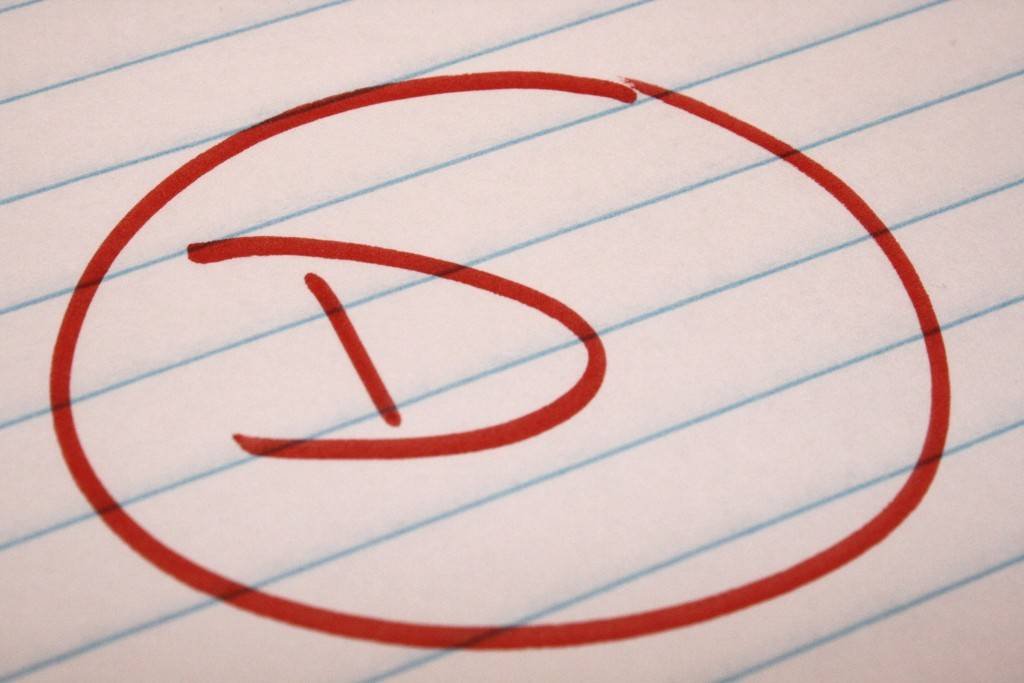
Ranges are typical rather than universal. Schools that use plus and minus grading adjust these values, and a D minus may carry roughly 0.7 grade points.
What grade is a D?
A D is the lowest letter grade above failing at most institutions. It sits between a C and an F, generally representing 60 to 69 percent of possible points and about 1.0 on a four-point scale.
What is a passing grade in college?
The answer depends on the context. In many undergraduate programs, a D is a passing mark. In graduate programs, the standard is usually higher. Graduate students often need a B or better to remain in good academic standing.
Is a D a failing grade?
In most undergraduate courses, it is not a failing grade. However, in some degree programs, a D does not meet major or prerequisite requirements and may function like a failing mark for progression.
Can you pass a college class with a D?
Yes, in most cases you can pass the class and keep the credit. Whether that credit does everything you need it to do is the harder question, since prerequisites, major requirements, transfer policies, and your cumulative GPA all apply separate standards.
Do You Have to Retake a Class After a D?
You may not need to repeat courses if the D meets your school’s general rules. If the class is an elective, you may keep the grade and move on. But if the D is in a required class for your degree program, you may need to retake it to meet the degree requirements.
Some institutions allow grade replacement. In that case, the new mark replaces the old one when the school calculates your grade point average (GPA). Other schools count both attempts in the GPA, which can affect your academic standing.
Students receiving financial aid must check how repeated classes count toward progress. Financial aid offices review credit completion and GPA. Repeating a course can affect both measures.

Can You Graduate With a D?
In some cases, you can graduate with a D in a general education course. If the school accepts it as passing, it may count toward your total credits. However, many majors require higher marks in core courses.
The second requirement is cumulative. Most undergraduate programs will not confer a degree with a GPA below 2.0, which is a C average across all coursework. A handful of D grades can sit on your transcript without issue if your other results are strong. A pattern of them makes it difficult to hold that 2.0 threshold.
If a D appears in a key class for your degree program, you may need to retake it. Schools often require at least a C in major courses to complete the required curriculum. The academic catalog explains how each mark applies to graduation.
For graduate students, rules are stricter. Many graduate programs do not accept a D as a passing grade. A D may require a retake or place the student at risk of dismissal under academic standing policies.
Will a D Transfer to Another College?
This is where a D most often causes problems. A D may transfer for credit, but acceptance depends on the receiving institution, and many accept transfer credit only if the original mark was a C or higher.
That gap surprises students who assumed a passing grade would travel with them. You can pay for a course, pass it, earn the credit at your current school, and still need to repeat the same material after transferring.
Even when a D does transfer, it may count only as elective credit and not toward a major. Transfer policies often differ from internal graduation rules, so a course that let you earn credit at one school may not satisfy requirements at another.
Always review transfer guides or speak with an admissions advisor or a college transfer consultant before relying on a D for transfer purposes. It is also important to review the official transfer application deadline when planning your next steps.
Is Getting One D in College Bad?
One D does not define your academic record. Still, it lowers your GPA because a D carries fewer quality points, which can affect academic standing. A lower GPA may also influence honors, scholarships, or admission to selective programs. Learn more about how GPA matters in college.
If your GPA drops below the required level, you may face academic probation. Academic probation is a warning period that requires improvement. Continued low marks can lead to suspension.
Context matters. One low grade among strong results often has a limited long-term impact. Academic dishonesty, however, carries serious penalties and can affect academic standing beyond GPA concerns.
How to Check Your School’s Grading Policy
Policies differ from one institution to another. Always review your school’s official documents. The registrar’s website and academic catalog explain the grade system and define the lowest passing mark.
You can also meet with a faculty member or academic advisor. They can explain how a given result affects your degree program and future classes. Students receiving financial aid should confirm details with the aid office to avoid surprises.
Ask three specific questions: does this course require a C or better for my major, will a D satisfy the prerequisite for the next class in the sequence, and how will this affect my cumulative GPA against the graduation minimum.
Quick Summary: When Is a D Passing?
A D is usually considered passing in undergraduate programs, but it has limitations. Whether it works for you depends on the situation.


