
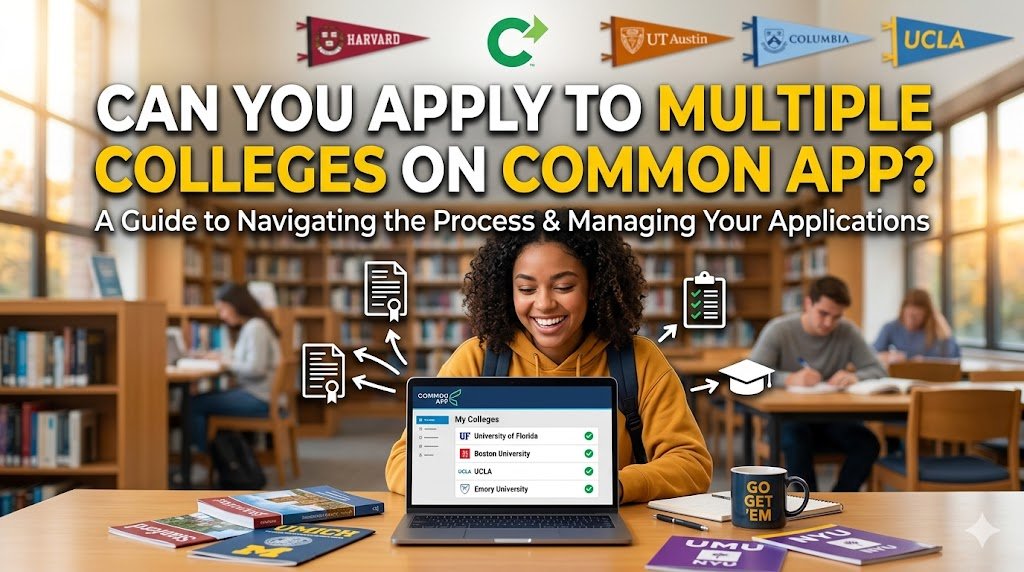
Yes. A student can apply to many colleges through Common App, and the current platform rule allows you to apply to up to 20 colleges.
For readers trying to answer how many colleges you can apply to on the Common App? The direct response is 20 through the platform, not unlimited.
The Common App also serves more than 1,000 participating schools, so a single account can cover a large share of a student’s list.
Key Takeaways
- Common App lets students apply to up to 20 colleges.
- The 20-school cap is a platform rule, not a suggested number.
- A strong college list should include reach, match, and likely schools.
- Common App does not mean every college application is free.
- Applying to too many colleges can lead to more essays, more deadlines, and more fees.
Is There a Limit on Colleges on the Common App?
The Common App 20 college limit is a real platform rule.
Common App’s support center states that students may add and apply to up to 20 colleges and that they may add or remove a college before submitting an application.
That means the cap applies inside the platform itself, even though a student’s full admissions plan may involve other application paths.
Why Does Common App Limit to 20?
For the question why does common app limit to 20?, the most careful answer is that the help page states the rule but does not give a long public answer as to why.
In practice, the cap works as a system boundary, not as advice about the ideal number of schools.
Students still need to manage deadlines, writing supplements, recommendations, and payment steps for every college on the list, so a firm ceiling helps keep the process organized.
This final point is an inference based on how Common App structures college requirements and submission tasks.

What Is the Common Application?
The Common Application is a shared college application platform that allows students to apply to more than 1,000 participating colleges and universities through a single system.
Common App offers first-year and transfer pathways, along with tools for exploring colleges, tracking requirements, and organizing materials.
Its first-year guide also stresses that filling out an application takes time and that students should stay organized as they work through multiple schools.
Colleges on Common App and Other Platforms: Not every college uses Common App.
The platform’s college search shows schools that accept it, so students may still find colleges that use their own applications or another system.
When reviewing common application colleges, it helps to treat Common App as one major application route rather than the only route in the admissions process.
That distinction matters most when a student is building a final list across different deadlines and systems.
Application Fees and Fee Waivers
Using Common App is not the same as applying to every school for free.
Common App’s 2025 fee resource says that many colleges do not charge an application fee, that 500+ colleges have no fee for domestic students, and that 500+ have no fee for international students.
The same resource explains that the Common App Fee Waiver can waive application fees for eligible students, and that a counselor confirms eligibility while the student can still submit their application.
How Many Colleges Should You Apply to on Common App?
There is no single correct number for every applicant.
College Board’s BigFuture guidance recommends a balanced list that includes at least six colleges, often with three reach schools, two match schools, and one safety school.
That does not mean every student should stop at six, but it does show that the platform cap is a ceiling, not a target. A shorter list can be stronger if each school clearly fits the student’s goals, budget, and application bandwidth.
So before applying on your common app account, it is best to investigate the colleges you have as options and know which ones you would consider as potential choices.
Reach, Target, and Likely Schools
A balanced list works because each category serves a different purpose.
Reach schools may be harder to enter based on recent academic profiles, match schools line up more closely with the applicant’s record, and likely schools provide important realistic options.
BigFuture also recommends looking beyond application requirements by comparing location, campus life, size, majors, and cost.
That broader review often produces a better final list than chasing the highest-ranked names alone.
Fees, Essays, and Workload
The number of applications should also align with the time available to complete them.
Common App’s student guide notes that colleges can have their own writing, testing, and deadline requirements, and its fee guide shows that costs can vary by college.
This is where many students feel pressure: more schools can create more opportunities, but they also create more essay work, more deadlines, and more room for mistakes.
A larger list only helps when the student can still submit careful, complete applications.
How to Add Colleges to Common App
The process is simple.
For students searching for how to add colleges to common app, Common App’s support page says to open College Search, look up the school using the search filters, and then choose the option to add it to My Colleges.
Once the school is on the list, the student can review requirements, deadlines, writing sections, and submission steps inside the account.
Steps to Build Your College List
A good list usually starts before any application is submitted.
Students can begin by identifying academic fit, cost range, size, geography, campus setting, and intended major, then narrowing the list to schools that truly meet those needs.
The better first move is often to review whether each added school still serves a clear purpose. Adding a college is easy, but keeping a focused list takes judgment.
Common Mistakes to Avoid: Too Many Reach Schools
One of the biggest planning errors is loading the list with highly selective colleges and leaving too little room for match and likely options.
BigFuture’s framework is useful here because it pushes students toward balance instead of wishful thinking. A list built solely around the most competitive schools can create more stress without improving the plan’s overall quality.
A balanced list gives the student more real choices later in the cycle of the college application process.
Ignoring Fit, Cost, and Deadlines
Another mistake is focusing only on admission odds or name recognition.
BigFuture advises students to compare cost, location, size, campus life, and majors, and Common App’s tools show application deadlines, fees, and writing requirements school by school.
Those details affect whether a college is practical to apply to and realistic to attend.
Near the end of this process, we at CollegeCommit review these decisions in a 100% online setting, starting with planning questions, because a smart list usually comes from fit and process discipline rather than from applying to the most schools possible.