



A good weighted GPA usually means strong grades in challenging classes. In many high schools, a weighted GPA above 4.0 is considered strong, but the exact number depends on the school’s grading scale and course rigor. Colleges evaluate GPA by looking at transcript details, course rigor, and the grading system used by each high school.
Understanding weighted GPA helps students and families interpret academic performance during the college admissions process, as grades can exceed the traditional 4.0 scale when schools add points for harder classes.
Key Takeaways
- A good weighted GPA usually reflects strong grades in advanced or challenging courses and often appears above the traditional 4.0 scale because schools add extra points for harder classes.
- Colleges review GPA in context by examining transcripts, course difficulty, and grading systems rather than relying on a single number alone.
- Both weighted and unweighted GPAs provide useful information, since one shows course rigor while the other reflects the raw grades earned across classes.
- A GPA of around 3.7 or higher can be competitive for many universities, though expectations vary by college selectivity.
- Admissions decisions involve many factors beyond GPA, including course selection, extracurricular activities, essays, and recommendations.
What Weighted GPA Is Considered Good in High School
A weighted GPA is considered strong when it reflects high grades in challenging classes such as honors, AP, or other advanced courses. In many high schools, this often means a GPA above 4.0, though the exact number depends on the school’s GPA scale and grading system.
Rather than focusing on a single number, admissions officers look at how that GPA was built. They review the transcript, the difficulty level of each class, and whether the student consistently chose more rigorous options. This is why the same GPA can be viewed differently depending on the academic context.
Typical Weighted GPA Ranges
Most weighted GPAs fall between 3.5 and 5.0, depending on the school’s GPA scale and GPA calculation method. Students in mostly regular classes may stay closer to 4.0, while students in honors classes, AP classes, or other advanced courses often earn higher numbers.
Because weighted GPA includes both grades and course rigor, the same number can mean different things at different high schools. That is why weighted and unweighted GPAs should always be interpreted within the school’s grading system.
What GPA Range Is Strong for Most Colleges?
For many colleges, a weighted GPA above 4.0 is often seen as strong, especially when it comes from challenging classes, and knowing the GPA needed to get into college overall helps put that number in context. Students with weighted GPAs in the high-3.0 to low-4.0 range may still be competitive if they earned solid grades in a demanding academic schedule.
Admissions officers do not rely on the number alone. They look at academic performance across the transcript and consider whether the student took the strongest courses available at that school.
What Is a Good Weighted GPA for the Ivy League?
The most selective universities receive applications from students with very strong academic records. Many applicants report an average weighted GPA for the Ivy League above 4.3, depending on their school system.
These schools expect students to take the hardest courses available, especially at institutions listed among the lowest acceptance rate colleges.
Still, GPA alone does not determine admission. Selective colleges review transcripts, essays, activities, and recommendations together. A strong GPA supports the application but does not guarantee admission.
How Weighted GPA Works
Weighted GPA gives extra value to grades earned in more challenging classes. Many high schools add points to honors classes, AP classes, or other advanced courses so the GPA reflects both the letter grade and the level of difficulty.
For example, an A in a regular class may count as 4.0 on the traditional 4.0 scale, while the same grade in an advanced class may count as 4.5 or 5.0. This is how weighted and unweighted GPAs begin to differ.
How Weighted GPA Is Calculated
Schools start by converting each letter grade into a number. They then add extra points for advanced courses and average those values across all classes to complete the GPA calculation.
Because grading systems vary, weighted and unweighted GPAs are not always comparable across schools. Admissions officers usually read the GPA together with the transcript and school profile to understand how the number was built.

Why Weighted GPA Can Exceed 4.0
Weighted GPA can go above the traditional 4.0 scale because advanced classes receive extra points. This often happens when students take several honors classes, AP classes, or other challenging classes during high school.
A GPA above 4.0 does not mean the student earned more than an A average in the usual sense. It means the school uses a weighted GPA scale that rewards stronger academic performance in harder coursework.
Typical Weighted GPA Ranges by Scale
Weighted GPA ranges depend on the GPA scale used by the high school. On a 5.0 scale, strong students often fall between 4.2 and 4.7, while on a 6.0 scale, strong students may appear above 5.0. At schools that stay close to the traditional 4.0 scale, a weighted GPA just above 4.0 can already reflect solid work in advanced classes.
These ranges are only rough benchmarks. Colleges look at weighted GPA in context, which means they compare the number with the school’s grading system, the transcript, and the level of course rigor before deciding how strong the record really is.
Weighted vs Unweighted GPA
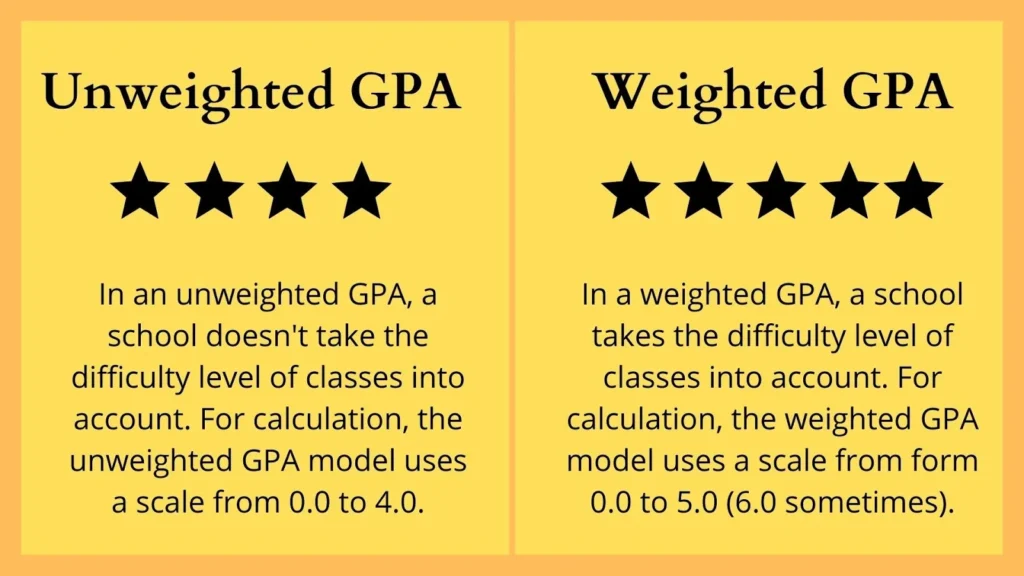
The comparison between weighted and unweighted GPAs can cause confusion. A weighted GPA includes course difficulty, while an unweighted GPA reflects grades without extra points.
Both numbers may appear on transcripts. Colleges review them together because each reveals a different part of the student’s academic record.
Does a weighted or unweighted GPA matter more?
It depends on how each college reviews transcripts. Many schools examine both numbers to understand grades and course difficulty.
Some readers first check the unweighted GPA to see raw grades. Others focus on the weighted GPA because it reflects how demanding the student’s schedule was.
Do Colleges Look at Weighted GPA?
Yes, many colleges do look at weighted GPA during admissions review. Colleges evaluate GPA by looking at course rigor, transcript details, and the grading system used by each high school.
It helps admissions officers see whether a student earned strong grades while taking honors classes, AP classes, or other advanced courses.
Do Colleges Care About Weighted GPA?
Yes, but mostly because it shows course rigor rather than just a number. Colleges want to know whether a student challenged themselves and performed well in that context.
Weighted GPA matters, but it is only one part of the review. Admissions teams also consider unweighted GPA, grade trends, essays, activities, and recommendations.
How Colleges Evaluate GPA and Course Rigor
Admissions readers study transcripts to understand the student’s academic program, which is part of the larger question of what grades colleges look at during review. They look at the courses available and the ones the student chose.
This process allows them to compare students from different schools. A transcript with strong grades in challenging classes may stand out even if GPA numbers vary.
Why Colleges Recalculate GPA
Some universities recalculate GPA using their own formula. This removes differences created by varying school grading systems.
Recalculation helps admissions teams compare applicants more fairly. The goal is to evaluate students using a consistent standard.
Factors That Affect GPA Evaluation
Several factors influence how colleges interpret GPA. These factors help admissions teams understand the student’s academic environment.
Colleges often review transcripts along with the school profile. This document explains grading policies and course offerings.
High School Grading Systems
Different high schools calculate GPA in different ways. Some schools emphasize weighted systems, while others keep traditional grading scales.
Admissions offices review the school profile to understand these policies. This context helps them interpret GPA more accurately.
Course Rigor and Advanced Classes
Students who complete several advanced courses often show readiness for college-level work. These classes require stronger study habits and a deeper understanding.
Courses such as honors classes and AP classes often signal academic ambition and preparation.
Why GPA Alone Does Not Determine Admission
GPA is only one part of the admissions review, and what colleges look at besides grades includes essays, activities, and recommendations alongside the rest of the application.
The full application shows both academic ability and personal achievements, though many families also ask whether they need recommendation letters for college as part of that fuller picture. GPA provides useful evidence of academic readiness but does not determine admission on its own.
College admissions decisions depend on many factors beyond grades. At CollegeCommit, students can work with a college application consultant to interpret academic records, understand admissions expectations, and plan thoughtful application strategies.
Ready to transform uncertainty into opportunity? Join our upcoming cohort at CollegeCommit: Where Preparation Becomes Placement.
FAQs About Weighted GPA