


Harvey Mudd College is the highest-priced school in the country for the 2026-27 academic year, with a published total of about $102,312 for tuition, fees, housing, and food. The University of Chicago follows at roughly $100,809, and the University of Southern California at $99,288.
That answer depends on how you define cost. When rankings measure total cost of attendance rather than tuition by itself, small private schools and urban campuses cluster at the top, and the order shifts from year to year. Pepperdine, once the long-standing answer to this question, has since fallen out of the top 20 as other schools raised their published totals faster.
This piece explains how schools get compared, why published prices vary between sources, and why the sticker figure rarely reflects what families actually pay.
Table of Contents
ToggleKey Takeaways
- Harvey Mudd College ranks first for 2026-27 at roughly $102,312, followed by the University of Chicago and USC.
- Rankings measure total yearly cost, including tuition, fees, housing, and food, not tuition alone.
- Pepperdine led earlier lists built on 2023-24 data and has since dropped out of the top 20 as other schools raised published totals faster.
- Sticker figures are estimates before aid. Northwestern and Haverford both publish totals near $96,000 but report average net prices below $25,000.
- Art and design schools carry the highest net prices in the country, even though they rarely appear on sticker-price lists.
What Is the Most Expensive College in the U.S. Per Year?
Annual rankings compare schools using official cost-of-attendance budgets. These budgets assume full-time enrollment and standard on-campus living. When analysts name the most expensive college in the US, they mean the school with the highest published all-in yearly estimate.
This method allows consistent comparison across institutions. It also explains why some campuses with lower tuition still rank high once housing and food get counted. The top-ranked school shifts year to year based on how those pieces are calculated.
What Is the Most Expensive College in the U.S. in 2026?
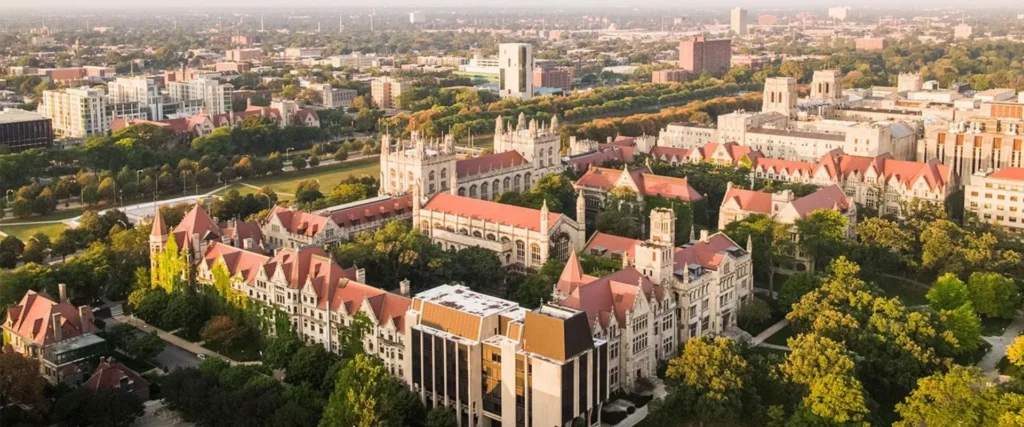
For 2026-27, Harvey Mudd College sits at the top at roughly $102,312, based on published tuition, fees, housing, and food. The University of Chicago crosses $100,000 for the first time at $100,809, driven by the country’s highest tuition and fees at $79,395.
USC lands third at $99,288. Claremont McKenna, Barnard, and Wesleyan all fall between $98,000 and $99,000, which means the gap between fourth and tenth place is under $2,100.
High tuition alone does not put a school at the top. Rankings move each year as universities adjust housing rates, meal plans, and personal expense assumptions.
Is Pepperdine the Most Expensive College?
Not anymore. Pepperdine ranked first on lists built from 2023-24 federal data, when its total reached $93,512, and that ranking still circulates widely. For 2026-27, Pepperdine University publishes tuition and fees of $75,202 plus housing and food of $20,490, for a total near $95,692.
That figure would have led the country three years ago. It now places Pepperdine around 25th, because schools like Harvey Mudd and UChicago raised published totals faster over the same stretch.
The same lag applies to any ranking you read: it’s a snapshot of a specific academic year, and rankings built on federal data typically run two years behind the current cycle.
How College Costs Are Measured
Schools calculate cost of attendance using federally defined categories. The published sticker figure represents a standard budget, not what most undergraduates pay, given average college tuition and total costs. It shows the maximum expected outlay before aid. Required for transparency, it often confuses instead.
Tuition Only
Tuition forms the academic base of what a school charges. Institutions list tuition and fees separately from living expenses. These charges cover instruction and required academic services, not housing, food, or personal spending.
The split is wider than most families expect. Pepperdine tuition is $75,202 for 2026-27, while its full budget is roughly $95,692. That $20,000 gap is entirely room, board, and fees.
Room, Board, and Total Cost
Housing and food add heavily to yearly budgets, ranging from about $18,800 at Boston College to $24,782 at Harvey Mudd. Rankings that identify the priciest campuses include these amounts because most undergraduates must pay them.
Schools in urban areas or with mandatory on-campus housing tend to rank higher. This is why totals differ widely even between institutions with similar tuition.
How These Rankings Were Built
Figures on this page reflect published tuition, mandatory fees, housing, and food for the 2026-27 academic year, drawn from each school’s official cost listings and cross-checked against national rankings. This excludes books, transportation, health insurance, and personal spending.
That exclusion matters. A student’s real yearly budget runs $2,000 to $4,000 above the totals shown here. Some 2026-27 figures remain estimates pending board approval, and schools define fees and housing categories differently, so treat the order as directional rather than exact. Carnegie Mellon’s two official figures, covered later in this piece, show exactly how much that definition can move a school’s rank.
Columbia University is absent from most 2026-27 rankings because it had not released official cost figures when those lists were compiled.
The Most Expensive Colleges in the US
The priciest campuses share patterns tied to funding models, size, and location. Nearly all are private and highly selective. Cost alone signals nothing about academic quality or what families ultimately pay.
Top 15 Schools by Total Annual Cost, 2026-27
| School | Location | Tuition & Fees | Room & Board | Total |
|---|---|---|---|---|
| Harvey Mudd College | Claremont, CA | $77,530 | $24,782 | $102,312 |
| University of Chicago | Chicago, IL | $79,395 | $21,414 | $100,809 |
| University of Southern California | Los Angeles, CA | $77,336 | $21,952 | $99,288 |
| Claremont McKenna College | Claremont, CA | $75,720 | $23,270 | $98,990 |
| Barnard College | New York, NY | $75,592 | $23,258 | $98,850 |
| Wesleyan University | Middletown, CT | $76,620 | $21,660 | $98,280 |
| Tufts University | Medford, MA | $76,558 | $20,594 | $97,152 |
| Brown University | Providence, RI | $77,552 | $19,464 | $97,016 |
| Washington University in St. Louis | St. Louis, MO | $72,722 | $24,272 | $96,994 |
| Vassar College | Poughkeepsie, NY | $77,160 | $19,800 | $96,960 |
| Georgetown University | Washington, DC | $74,732 | $22,180 | $96,912 |
| Vanderbilt University | Nashville, TN | $73,206 | $23,690 | $96,896 |
| Colgate University | Hamilton, NY | $77,290 | $19,356 | $96,646 |
| Duke University | Durham, NC | $73,740 | $22,857 | $96,597 |
| Trinity College | Hartford, CT | $76,150 | $20,330 | $96,480 |
Three patterns stand out. Small liberal arts campuses are heavily represented, with Harvey Mudd, Claremont McKenna, Barnard, Wesleyan, Vassar, Colgate, and Trinity all in the top 15. Location raises costs in Los Angeles, New York, and Washington, but Vassar in Poughkeepsie and Colgate in rural New York rank just as high.
The $100,000 year has also arrived. Two schools now cross it on billed charges alone, before books or travel.
Why Rankings Disagree With Each Other
Carnegie Mellon University shows how methodology changes the answer. Its official 2026-27 cost of attendance reads $93,614 for entering first-years and $96,106 for returning undergraduates, which looks like top-15 territory.
Strip out books, personal spending, and estimated loan fees, and CMU’s billed tuition, fees, housing, and food total roughly $91,214. That drops it below every school in the table above.
Neither figure is wrong. One measures what the school bills; the other measures a full spending budget. When two published rankings disagree by $5,000 on the same campus, this is usually why.
Where Ivy League and Peer Elite Schools Actually Land
The assumption that Ivy League schools top cost rankings does not hold. Brown ranks eighth for 2026-27, Cornell nineteenth, and Dartmouth twenty-third. Harvard University, Yale University, and Princeton University do not appear in the top 30. Stanford University and Northwestern University, often grouped with the Ivy League in public perception though neither is a member, follow the same pattern.
Large endowments help. Schools with the deepest financial resources face less pressure to raise published rates, and several deliberately cap tuition growth. Columbia University and the University of Pennsylvania both ranked higher on older lists built from 2023-24 data. For families comparing within the group, the cheapest Ivy League school is often a more useful question than which one ranks highest.
Northwestern University makes the point sharply. It ranks twenty-first at $96,003 while reporting an average net price near $23,341, roughly a quarter of the sticker figure.
Top 100 Most Expensive Colleges
Federal data covering nearly 2,000 institutions shows how far the tier extends. Federal data reported by BestColleges shows around 250 schools now publish yearly totals above $65,000 for out-of-state undergraduates living on campus, up from fewer than 100 five years earlier.
Extending the ranking to 100 adds mostly private universities and liberal arts campuses in the $85,000 to $95,000 band. Boston University, Bowdoin, Pomona, Swarthmore, Williams, Wellesley, Amherst, Haverford, Boston College, Hamilton, and Colby all fall in that range for 2026-27.
Public universities are largely absent from the top 100 by total cost; see our top public universities roundup for how their pricing compares. Their published totals generally sit well below the private-school range shown above, even for out-of-state students paying non-resident tuition.
Schools That Cost Less Than Their Reputation Suggests
Two names come up often in cost searches without appearing in national rankings.
High Point University in North Carolina draws attention for its campus amenities and marketing, which leads families to assume premium pricing. Its published total runs well below the $95,000 tier, closer to the middle of the private university range.
Texas Christian University follows the same pattern. It isn’t even the most expensive college in Texas, let alone nationally, once you compare full totals. Both cases show how reputation and price track separately, and why a consistent definition matters before comparing any two campuses.
Sticker Price vs. Net Price
The published figure and the paid figure are different numbers. Net price is what remains after grants and scholarships, and it is the more useful metric for planning.
Many schools at the top of sticker rankings meet 100% of demonstrated need.
UChicago and Northwestern both do so without loans. Vanderbilt covers full tuition for families earning $150,000 or less, and Haverford removes loans entirely for families under $60,000.
The schools with the highest net prices in the country are rarely the ones on sticker lists. Art, design, and music conservatories dominate, because they combine high tuition with smaller aid budgets.
| School | Type | Average Net Price |
|---|---|---|
| The New School | Private, nonprofit | $62,226 |
| Ringling College of Art and Design | Private, nonprofit | $60,362 |
| School of Visual Arts | Private, for-profit | $59,211 |
| California Institute of the Arts | Private, nonprofit | $57,288 |
| School of the Art Institute of Chicago | Private, nonprofit | $55,485 |
| Loyola Marymount University | Private, nonprofit | $54,471 |
| Pepperdine University | Private, nonprofit | $52,216 |
| Manhattan School of Music | Private, nonprofit | $51,879 |
| Syracuse University | Private, nonprofit | $51,520 |
| Emerson College | Private, nonprofit | $50,703 |
Net price figures reflect the most recent federal data available (2022-23) and predate the 2026-27 sticker totals shown elsewhere on this page.
Compare those figures against Northwestern at $23,341, Haverford at $22,828, Vanderbilt at $26,689, and Barnard at $27,738. A school listed at $96,000 can cost a family less than one listed at $76,000.
Run each school’s net price calculator before ruling anything out on sticker alone. The order of your list often reverses once real aid offers arrive, and that gap is often where it makes sense to negotiate college tuition directly with the financial aid office.
How U.S. Colleges Compare Worldwide
Global comparisons place American schools near the top. In the United States, universities rely more heavily on tuition revenue than many international peers. This structural difference drives higher published totals, and national funding models explain most of the gap.

he Most Expensive College in the World
International lists routinely place U.S. institutions above those in other countries. Public funding abroad limits academic charges and lowers totals. American schools also bundle housing and personal expenses into published budgets, which raises the reported number even when underlying costs are similar.
Harvey Mudd’s $102,312 total exceeds published costs at nearly every university outside the United States, including institutions in Switzerland, the United Kingdom, and Singapore.
Top 10 Most Expensive Universities in the World
Global lists mix American private schools with a small number of international institutions:
- Harvey Mudd College (US) – about $102,312, the highest published total worldwide
- University of Chicago (US) – about $100,809, driven by the highest tuition in the country
- University of Southern California (US) – about $99,288, driven by Los Angeles living costs
- Claremont McKenna College (US) – about $98,990 for a small residential campus
- Barnard College (US) – about $98,850, with Manhattan housing as the main driver
- Wesleyan University (US) – about $98,280 for a private liberal arts model
- Tufts University (US) – about $97,152, shaped by greater Boston costs
- Brown University (US) – about $97,016, the highest-priced Ivy League school
- ETH Zurich (Switzerland) – low tuition for EU and Swiss residents, but living costs among the highest in Europe for international applicants
- Imperial College London (UK) – among the costliest options for international applicants once London housing is counted
Nine of the ten highest published totals sit in the United States, and the two international entries reach the list mainly through living expenses rather than academic charges.

Common Misunderstandings About College Cost
Many families assume published totals reflect what everyone pays. Rising sticker prices come from a mix of institutional spending, aid funding, and administrative costs; to understand why college costs so much, you need to break down those forces.
In practice, aid and grants reduce net cost for most undergraduates at selective private schools, and when an award falls short of expectations, families can learn how to ask for more money from a college before accepting or declining an offer. Financing tools, such as student loans, and other ways students pay for college, affect cash flow while increasing long-term financial responsibility.
A second misunderstanding is that price signals quality. The rankings above include a STEM specialist, several liberal arts campuses, and one Ivy League university, with no consistent relationship between cost and outcome.
A third is that rankings stay fixed once published. The same school can appear in very different positions across two rankings released months apart, depending on which academic year’s data each source uses and whether it counts a full spending budget or only billed charges; the same gap explains Carnegie Mellon’s two figures above.
Near the end of the research process, some readers look for structured guidance. At CollegeCommit, we help families interpret cost data, timelines, and application structures across higher education with support from a college application consultant, including Early Action, Early Decision, Restrictive Early Action, and Regular Decision, through a single, fully online model.
If you want help applying this information to your student’s situation, schedule a consultation to review options and next steps.

Frequently Asked Questions
What is the most expensive college in the US in 2026?
Harvey Mudd College, at roughly $102,312 for tuition, fees, housing, and food in 2026-27. The University of Chicago follows at $100,809.
Is Pepperdine the most expensive college?
Not currently. Pepperdine held the top position on rankings built from 2023-24 federal data and now sits around 25th at roughly $95,692 for 2026-27.
Why do some schools cost more than $100,000 per year?
Two now cross that line on billed charges alone. Add books, travel, health insurance, and personal spending, and more campuses pass $100,000 for individual undergraduates.
Do families actually pay the published price?
Some do; many do not. Schools like Northwestern and Haverford report average net prices below $25,000 despite publishing totals near $96,000.
What is not included in these totals?
Books, transportation, health insurance, technology, and personal expenses. Expect a real yearly budget $2,000 to $4,000 above the figures listed here.
Which schools have the highest net prices?
Art, design, and music schools. The New School, Ringling College, and the School of Visual Arts all report average net prices above $59,000, higher than any school on the sticker-price ranking.
Related Articles