


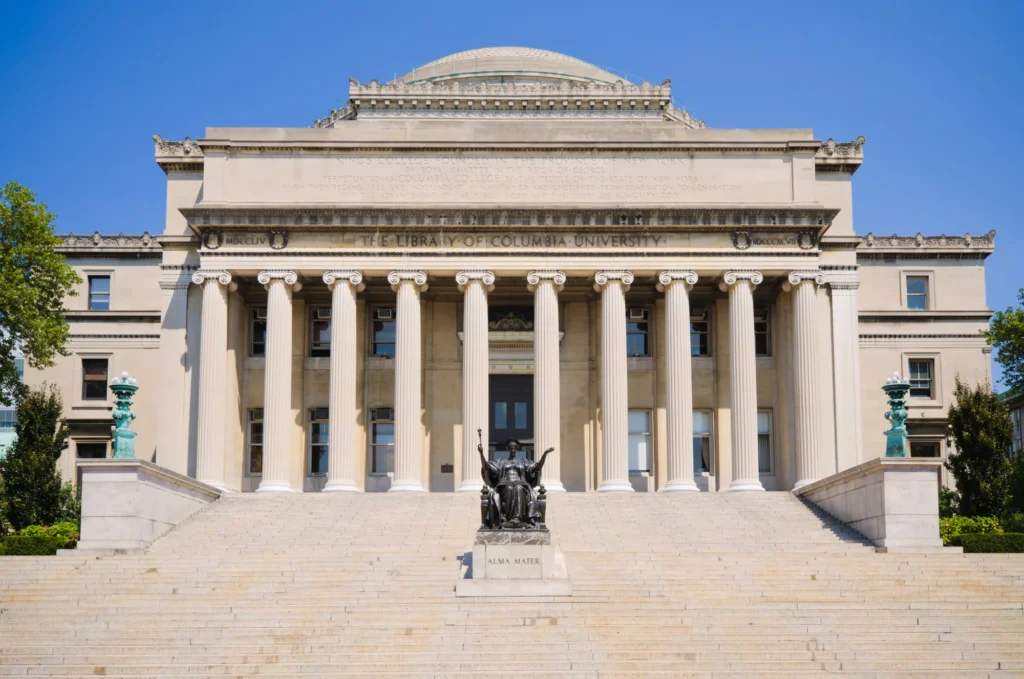
The Ivy League began as an athletic conference, not an academic ranking. Over time, its academic reputation became its defining feature.
This guide explains what Ivy League membership means. It also shows how Columbia compares to the other seven schools. It explains what the admissions process involves.
Table of Contents
ToggleKey Takeaways
- Columbia University has held full membership in the Ivy League since the conference was formed in 1954, making it one of the eight founding schools alongside Brown, Cornell, Dartmouth, Harvard, Princeton, Penn, and Yale.
- Columbia’s Manhattan campus sets it apart from the other seven schools, most of which are located in smaller college towns rather than in a major city.
- For the Class of 2029, Columbia admitted 4.29 percent of applicants, placing it close behind Harvard’s 4.2 percent and just ahead of Princeton’s 4.4 percent among the most selective schools in the group.
- All undergraduates at Columbia complete the Core Curriculum, a set of required courses in literature, philosophy, and history that applies regardless of major.
- Prospective students apply through the Common Application and can choose between binding Early Decision or non-binding Regular Decision.
Is Columbia an Ivy League University?
Yes, Columbia University is an Ivy League university and one of the eight founding members, alongside Brown, Cornell, Dartmouth, Harvard, Princeton, Penn, and Yale. The Ivy League is not a ranking system despite common assumptions.
It started as a group of private universities in the northeastern United States that competed against one another in athletics. Columbia’s status has not changed since the group’s founding in 1954.
Most people now associate the term “Ivy League” with academic prestige rather than sports, but the name began with football. Columbia’s reputation as a research university grew alongside its athletic history, and both remain part of its identity today.
The school is regarded as one of the most highly selective institutions in the country. Its undergraduate students benefit from small class sizes within certain programs and access to major research facilities.
How Columbia Joined the Ivy League
The Ivy League officially formed in 1954, when eight schools agreed to shared standards for academics and sports. Columbia was one of the original signers of that agreement.
Before the group existed, these schools had already competed against each other in football since the late 1800s. Sportswriters used the term “Ivy League” as early as 1937 to describe them.
Columbia’s inclusion was not based on a vote or a later invitation. It was a founding member from day one, alongside the other seven schools. That original agreement still defines Ivy League membership today. No school has been added or removed since 1954.
Is Columbia Ivy League in New York?
Yes. Columbia University is located in Manhattan, within New York City, in the Morningside Heights neighborhood. It is one of two Ivy League members in New York State, along with Cornell University in Ithaca.
Columbia’s city setting sets it apart from most other Ivy League campuses, which tend to be located in smaller towns such as Hanover, New Hampshire, or Princeton, New Jersey.
A student at Dartmouth might spend a Saturday hiking nearby trails, while a student at Columbia can catch a Broadway show or visit a museum on the same afternoon. Students at Columbia also have direct access to a large job market and a citywide transit system.
What Is the Ivy League?
The Ivy League is a group of eight private colleges in the northeastern United States, each operating as a private, nonprofit university.
The term started as a reference to a sports league rather than an academic ranking. Over time, these schools built reputations for selective admissions, strong research programs, and large financial endowments.
The group became official in 1954, though the schools had competed in sports together for decades before that. Today, Ivy League membership carries more academic than athletic weight, even though the league is still active.
Each school follows a liberal arts model at the undergraduate level, even those with strong programs in engineering or business.
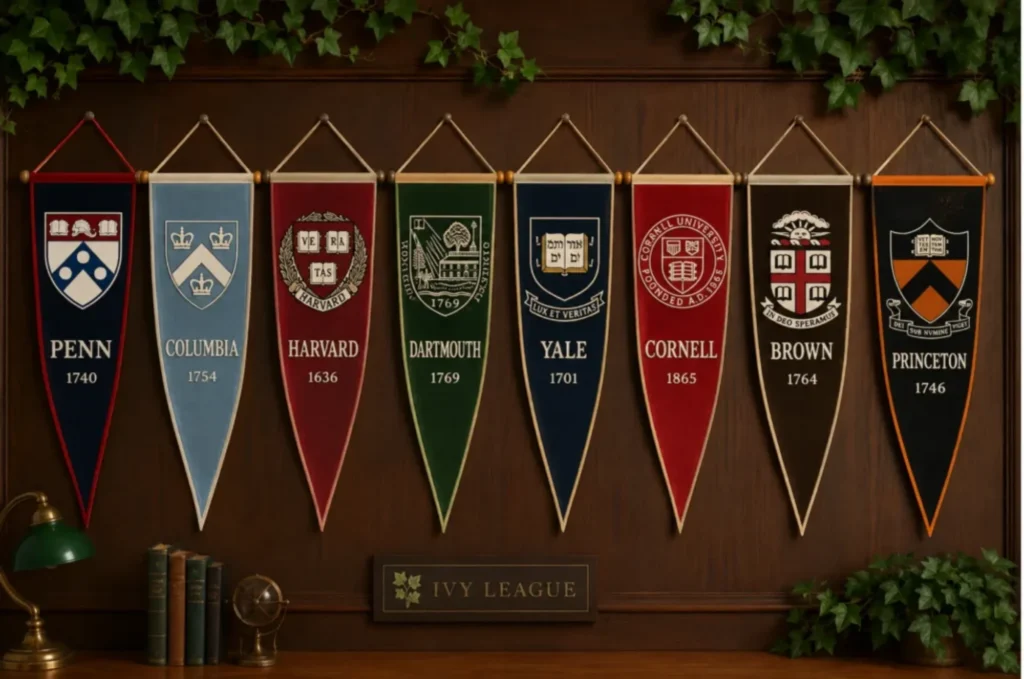
List of Ivy League Schools in the US
There are eight Ivy League schools in the United States:
- Brown University, in Providence, Rhode Island
- Columbia University, in New York, New York
- Cornell University, in Ithaca, New York
- Dartmouth College, in Hanover, New Hampshire
- Harvard University, in Cambridge, Massachusetts
- Princeton University, in Princeton, New Jersey
- University of Pennsylvania, in Philadelphia, Pennsylvania
- Yale University, in New Haven, Connecticut
This list has not changed since 1954. All eight schools are private and located within a few hundred miles of each other on the East Coast.
How Does Columbia Compare to Other Ivy League Institutions?
Columbia shares Ivy League status with the other seven schools, but sharing a label does not mean sharing an identical experience. Each school has its own strengths, size, and campus setting, and those differences often matter more to applicants than the shared name.
Comparing acceptance rates, location, and academic focus helps explain why families weigh these schools differently. The figures below reflect the most recently published data from each university and from national ranking organizations.
For a closer look at how these factors stack up across the group, see our guide to comparing Ivy League schools side by side.
Acceptance Rate and Selectivity
Columbia is one of the more selective schools in the group. For the Class of 2029, Columbia admitted 4.29 percent of applicants, according to data reported by the Columbia Daily Spectator.
That places it close to Harvard, which admitted 4.2 percent of its Class of 2029, and Princeton, which admitted 4.4 percent of the same class. For a full year-by-year breakdown, see our guide to Ivy League admission rates across all eight schools.
Is Columbia the hardest Ivy to get into? For the Class of 2029, Harvard posted the lowest admit rate among the eight schools at 4.2 percent, with Columbia close behind at 4.29 percent.
Cornell, by comparison, tends to admit a higher share of applicants and is often considered the easiest Ivy to get into, though it remains far more selective than most colleges outside the Ivy League.
Is Yale or Columbia harder to get into? For the Class of 2029, Columbia’s 4.29 percent admit rate was slightly lower than Yale’s 4.59 percent, making Columbia marginally harder to get into that year. The gap between the two schools has historically stayed within a percentage point and can shift from one cycle to the next.
Location, Academics, and Prestige
Columbia’s Manhattan location is one of its clearest points of difference from the rest of the Ivy League. Most other schools in the group sit in smaller college towns, while Columbia offers direct access to New York’s industries, internships, and cultural life. This shapes the day-to-day student experience in ways that a rural or suburban campus cannot.
Academically, Columbia is known for its Core Curriculum, a set of required courses in literature, philosophy, and history that all undergraduates complete regardless of major. A future engineering student at Columbia will still read Homer and Plato alongside everyone else on campus.
The school’s undergraduate division, Columbia College, is the oldest college within the university, tracing its roots back to 1754.
Columbia is also the oldest institution of higher education in the state of New York, having been chartered in 1754 as King’s College.
Its student body includes a large share of international students, drawn by the university’s location and global reputation. Faculty members across the university include leaders in law, journalism, and the sciences.
Is Columbia as prestigious as Harvard? Both schools carry strong name recognition. Harvard has a slight edge in overall global rankings, partly due to its older founding date and larger endowment. But in subject-specific rankings, such as those covering journalism and law, Columbia’s reputation matches or beats Harvard’s.
How Do You Apply to Columbia University?
Columbia accepts applications through the Common Application, and prospective students can apply under Early Decision or Regular Decision. Early Decision is binding, meaning admitted students must attend Columbia and withdraw applications from other schools.
Regular Decision applicants can wait to compare offers before committing. Families researching strategies across the whole group can also read our guide to getting into the Ivy League.
A complete application typically includes high school transcripts, standardized test scores, if submitted, letters of recommendation, lists of extracurricular activities, and several essays, including Columbia-specific supplements.
The university considers a student’s full academic record, not a single test score or GPA figure, when making admissions decisions. This reflects the same broad review standard that Ivy League schools look for more generally.
Columbia’s supplemental essays ask students to reflect on why Columbia fits their goals and how they would use the city and the Core Curriculum to their advantage.
A student who writes only about the Ivy League name, without anything specific to Columbia, tends to stand out for the wrong reasons. For essay strategy and academic benchmarks specific to this school, see our guide on how to get into Columbia.
As an Ivy League admissions consultant, we work with students preparing applications to Columbia and other Ivy League universities, helping them organize timelines and refine supplemental essay topics.
Because CollegeCommit operates 100% online, families can access this support from anywhere, whether they are based in New York or elsewhere in the country. Our role is to support the student’s own work, not to write it for them.

Frequently Asked Questions
Is Columbia Ivy League a Good School?
Yes. Columbia is widely regarded as one of the strongest research universities in the country, with recognized programs in journalism, law, international affairs, and the sciences.
Whether it is the right fit for a specific student depends on their academic interests and preference for an urban campus setting, a question tied closely to whether Ivy League schools are worth it for that student’s particular goals. Some students find they are better matched with one of the best non-Ivy League colleges instead.
Is Yale or Columbia Harder to Get Into?
Both schools post similarly low acceptance figures, typically in the low single digits. Neither school has a consistent edge in selectivity over the other, and the difference from year to year is usually small.
Related Articles


