


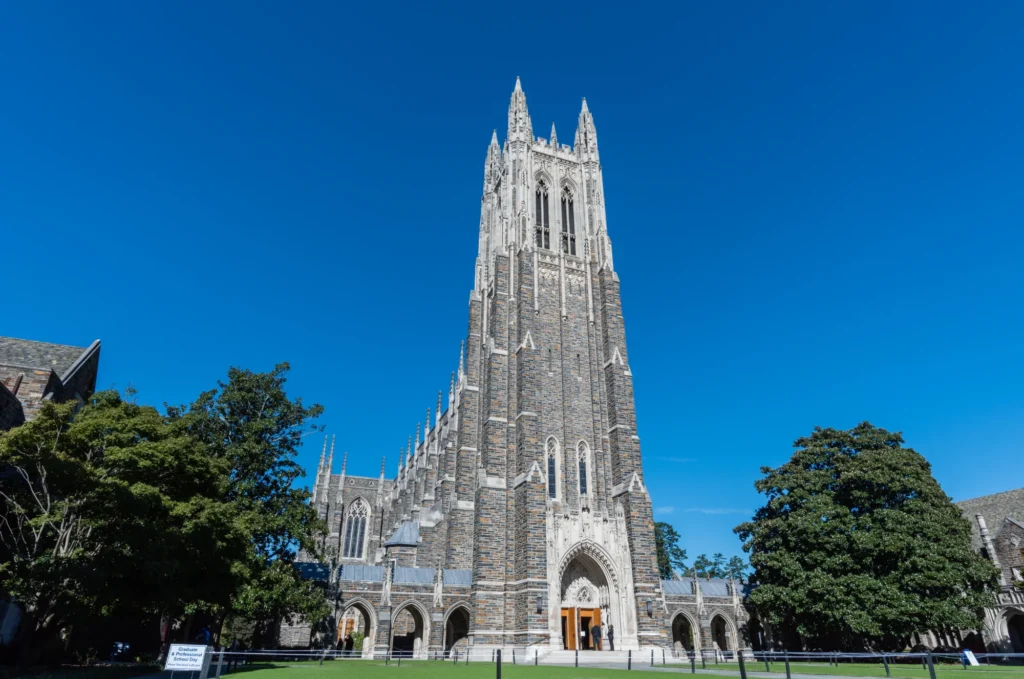
Understanding the difference between formal membership and academic standing helps explain why Duke is grouped with the Ivies. Duke is not technically an Ivy. The sections below explain where the two overlap.
Table of Contents
ToggleKey Takeaways
- Duke University is not an Ivy League school; the Ivy League is a fixed athletic conference of eight Northeastern universities formed in 1954, and membership was never open to Duke.
- Despite its outsider status, Duke’s acceptance rate, academic rankings, and career outcomes place it in the same tier as most Ivy League schools, which is why it is often called an “Ivy Plus” or “Hidden Ivy.”
- Duke ranked No. 7 among national universities in the most recent U.S. News list, putting it ahead of several actual Ivy League schools, including Dartmouth, Brown, and Cornell.
- Duke offers merit-based scholarships, an option most Ivy League schools do not provide since they rely exclusively on need-based aid.
- Students choosing between Duke and the Ivy League should weigh program fit and campus environment rather than assume that one name carries more weight in admissions or career outcomes than the other.
Is Duke University an Ivy League School?
No, Duke University is not an Ivy League school. The Ivy League includes exactly eight members: Brown, Columbia, Cornell, Dartmouth, Harvard, Princeton, the University of Pennsylvania, and Yale. Duke is not, and has never been, on that list. This is a factual distinction based on athletic conference membership, not academic ranking.
Duke University is a private research university located in Durham, North Carolina. It was founded in 1838 and has grown into one of the most selective schools in the United States.
Duke’s student body includes undergraduates and graduate students from nearly every state and dozens of countries. While it sits outside the formal Ivy League, Duke competes directly with Ivy League institutions for students, faculty, and research funding.
Why Isn’t Duke in the Ivy League?
The Ivy League is an athletic conference, not an academic ranking. It was formed in 1954 among the eight Ivy League schools in the Northeastern United States, and membership was based on athletic competition rather than academic quality. This history explains why several highly ranked schools sit outside the group.
Duke is a university located in the Southeast, not the Northeast, which placed it outside the geographic footprint of the original conference.
The same applies to Stanford, MIT, and the University of Chicago. None of these schools joined the Ivy League, regardless of how their academic programs compared with those of the founding members.
Over time, “Ivy League” shifted from a sports term to a general marker of academic prestige. This shift is part of why so many people assume the label applies to any highly selective university.
Duke’s academic standing often matches or exceeds several Ivy League institutions, even though it was never eligible for membership in the conference itself.
Why Do People Consider Duke an “Ivy Plus” or “Hidden Ivy” School?
Duke is often described as an “Ivy Plus” or “Hidden Ivy” school. Neither term is an official designation. Both are informal labels used by counselors and admissions professionals to describe schools that match Ivy League standards without carrying the Ivy League name.
“Ivy Plus” typically refers to a small group of best non-Ivy League colleges treated as equivalent to the Ivy League in admissions circles. This group usually includes Duke, Stanford, MIT, and the University of Chicago.
“Hidden Ivy” is an older term used to describe schools, often smaller or less well-known, that provide an education comparable to that of the Ivy League universities.
A few factors explain why Duke consistently earns these labels:
- Duke’s acceptance rate has remained in the single digits in recent years, generally near 6 percent. This places Duke within the same range as several Ivy League admission rates, though it still trails the hardest Ivy League school to get into.
- Duke consistently ranks near the top of major national rankings year after year.
- Duke’s graduates are recruited by many of the same employers and graduate programs as Ivy League graduates.
Counselors frequently place Duke in the same admissions category as the Ivy League when helping students build a college list. Duke’s reputation within higher education has grown steadily over the past several decades. This reflects selectivity and outcomes, not a formal ranking system or membership status.
How Does Duke Compare to Ivy League Schools?
Duke and the Ivy League overlap in several measurable areas, including acceptance rates, national rankings, and academic reputation. The comparison below looks at where Duke stands relative to the eight Ivy League universities, in the same way students compare Ivy League schools against each other. These areas give a clearer picture than reputation alone.
Rankings and Acceptance Rate
Duke University’s rankings on US college lists have placed it above several Ivy League schools, including Dartmouth, Brown, and Cornell, in multiple recent ranking cycles. This does not make Duke better than those schools overall.
But it does show that Duke’s academic standing is not below that of the Ivy League on most measures. Rankings shift slightly from year to year, so a single-year snapshot should not be treated as a permanent standing.
Among admitted students who submit test scores, Duke’s middle 50 percent range runs roughly 1500 to 1570 on the SAT and 34 to 35 on the ACT, a band that closely matches most Ivy League admits.
In national rankings, Duke has placed within the top ten among national universities in recent cycles. US News ranked Duke No. 7 in its latest Best National Universities list.
Duke tied with Johns Hopkins, Northwestern, and the University of Pennsylvania.
Only five schools ranked higher: Princeton, MIT, Harvard, Stanford, and Yale.
Duke University’s rankings on US college lists have placed it above several Ivy League schools, including Dartmouth, Brown, and Cornell, in multiple recent ranking cycles.
This does not make Duke superior to the University overall, but it does show that Duke’s academic standing is not a step below the Ivy League on most measures. Rankings shift slightly from year to year, so a single-year snapshot should not be treated as a permanent standing.

Academics and Program Strengths
Duke offers strong programs in biomedical engineering, public policy, economics, and global health. Duke’s Sanford School of Public Policy has a strong national reputation. Its location near Research Triangle Park gives students access to research and internships in technology and biotechnology. These partnerships give undergraduates hands-on exposure well before graduate school.
Duke’s Trinity College of Arts and Sciences provides a liberal arts education alongside the university’s research strengths. Students can pursue a broad academic foundation while still gaining access to advanced research typically associated with larger institutions.
Each Ivy League school has its own areas of specialization, so direct comparisons depend heavily on a student’s intended field of study.
Every full-time faculty member at Duke is expected to balance teaching with active research, a structure common at major private research universities. This model gives undergraduates access to research opportunities earlier than at some larger public institutions.
Academic excellence at Duke is reflected in its low student-to-faculty ratio and the availability of research funding across departments.
Most Duke undergraduates live on campus during their first three years, supporting a residential system similar to those at several Ivy League institutions. This structure encourages closer ties between students and faculty outside the classroom. Campus housing also plays a role in shaping the collaborative culture Duke is known for.
Prestige and Alumni Networks
Duke has a well-established alum network in consulting, finance, law, and healthcare. Employers such as major consulting and financial firms recruit from Duke at rates similar to those from the Ivy League. Top law and medical schools also draw heavily from Duke’s graduating classes.
Duke’s national visibility is also shaped by its NCAA Division I athletics program, particularly basketball, which gives it recognition outside strictly academic circles.
This visibility does not affect academic quality, but it does influence how the broader public perceives the school compared with Ivy League universities. Many applicants first hear about Duke through its athletics before learning about its academic programs.
Career Outcomes: Duke vs. Ivy League Graduates
Duke graduates pursue careers in consulting, finance, technology, healthcare, and law at rates comparable to graduates from Ivy League institutions.
Many Duke students continue to graduate school, including programs at Ivy League institutions in law, business, and medicine. Career services and alumni mentorship at Duke play a real role in these outcomes.
Career outcomes depend more on what a student does during their undergraduate years than on whether their school carries the Ivy League name.
A student who builds strong research experience, secures relevant internships, and takes on leadership roles at Duke can expect outcomes comparable to those of a student completing the same work at an Ivy League school. Graduate students from Duke are represented across top programs in nearly every professional field.
This does not mean the schools are interchangeable. Culture, location, and campus size vary enough to shape a student’s overall experience in different ways. When it comes to how employers and graduate schools evaluate degrees, Duke and the Ivy League are evaluated on largely similar terms.
Financial Aid and Cost at Duke vs. Ivy League Schools
Duke states that it meets 100 percent of demonstrated financial need for admitted students, based on a review of each family’s finances. Most Ivy League schools follow a comparable need-based tuition support policy for admitted students. Families should apply for aid early, since some aid-related deadlines fall before regular admissions deadlines.
One meaningful difference involves merit aid. Duke offers merit-based scholarships, while most Ivy League institutions rely exclusively on need-based financial aid. Students who do not qualify for need-based support but present a strong academic profile may find more favorable financial aid options at Duke than at an Ivy League school.
For the 2025 to 2026 academic year, Duke’s total cost of attendance is about $92,000, including tuition of about $70,000, plus room and board and fees. Ivy League schools fall within a similar range, with Yale’s total cost near $92,000 and Harvard’s near $87,000 for the same year.
Overall costs at Duke and the Ivy League fall within a similar range once tuition, fees, and typical aid packages are considered, though families comparing sticker prices may also want to see which Ivy League school is the cheapest. These figures reflect the full sticker price before aid is applied, so a family’s actual bill is often much lower.
Families should use each school’s net price calculator to estimate actual costs, since the listed tuition figure rarely reflects the amount a family will ultimately pay after aid is applied. Comparing net price rather than sticker price gives a far more accurate picture for budgeting purposes.
Should You Apply to Duke Instead of an Ivy League School?
Duke is a reasonable option for students who are still deciding whether Ivy League schools are worth it and want comparable academics and outcomes in a different campus setting or region.
Students focused on biomedical engineering, public policy, or global health may find that Duke’s specific programs align more closely with their goals than comparable Ivy League options. Fit and program strength often matter more than name recognition alone.
Duke and Ivy League institutions generally look for similar qualities in applicants: strong academic performance, well-defined interests, and extracurricular involvement that reflects genuine engagement.
The admissions process at Duke is as competitive as that of most Ivy League institutions, so students should evaluate fit and program strength rather than assume that one name carries more weight than another. Essays and recommendations carry heavy weight at both schools during committee review.
Application strategies for Duke often mirror those used for Ivy League institutions, including decisions around Early Decision, Early Action, Restrictive Early Action, and Regular Decision.
Students applying through the Common Application should research each school’s specific policies, since deadlines and requirements vary by institution even among similarly ranked schools.
Building a college list that includes both Duke and multiple Ivy League institutions is common practice for students targeting highly selective admissions outcomes. Some students round out that list with the easiest Ivy League school to get into as a strategic addition.
At CollegeCommit, our Ivy League admissions consultant team works with students who are weighing Duke against Ivy League and Top 20 schools as part of a broader college strategy.
Our advisors help families understand how selectivity, program strength, and student life at each school factor into a realistic admissions plan. This approach focuses on informed decision-making rather than predicting outcomes at any single institution.

Frequently Asked Questions About Duke and the Ivy League
Is Duke a top 10 university?
Yes, in recent rankings. U.S. News ranked Duke No. 7 among national universities, ahead of several Ivy League institutions, including Dartmouth, Brown, and Cornell.
Is Duke as prestigious as Harvard, Yale, or Princeton?
Duke ranks highly and has strong academic weight. Still, Harvard, Yale, and Princeton often rank slightly higher nationwide. They also have longer histories among the country’s most selective schools. In terms of career outcomes and graduate school admission, Duke performs at a broadly similar level.
Is Duke considered a “Public Ivy”?
No. Duke is a private university, and the “Public Ivy” label refers to public universities, such as the University of Virginia and the University of Michigan, that offer an education comparable to that of the Ivy League.
Does attending Duke instead of an Ivy League school affect job or graduate school prospects?
Generally, no. Employers and graduate schools view Duke as a top-tier university. A student’s coursework, research experience, and internships tend to matter more than whether the undergraduate degree is from an Ivy League school.
Frequently Asked Questions About Duke and the Ivy League
Is Duke a top 10 university?
Yes, in recent rankings. U.S. News ranked Duke No. 7 among national universities, ahead of several Ivy League institutions, including Dartmouth, Brown, and Cornell.
Is Duke as prestigious as Harvard, Yale, or Princeton?
Duke ranks highly and has strong academic weight. Still, Harvard, Yale, and Princeton often rank slightly higher nationwide. They also have longer histories among the country’s most selective schools. In terms of career outcomes and graduate school admission, Duke performs at a broadly similar level.
Is Duke considered a “Public Ivy”?
No. Duke is a private university, and the “Public Ivy” label refers to public universities, such as the University of Virginia and the University of Michigan, that offer an education comparable to that of the Ivy League.
Does attending Duke instead of an Ivy League school affect job or graduate school prospects?
Generally, no. Employers and graduate schools view Duke as a top-tier university. A student’s coursework, research experience, and internships tend to matter more than whether the undergraduate degree is from an Ivy League school.


