



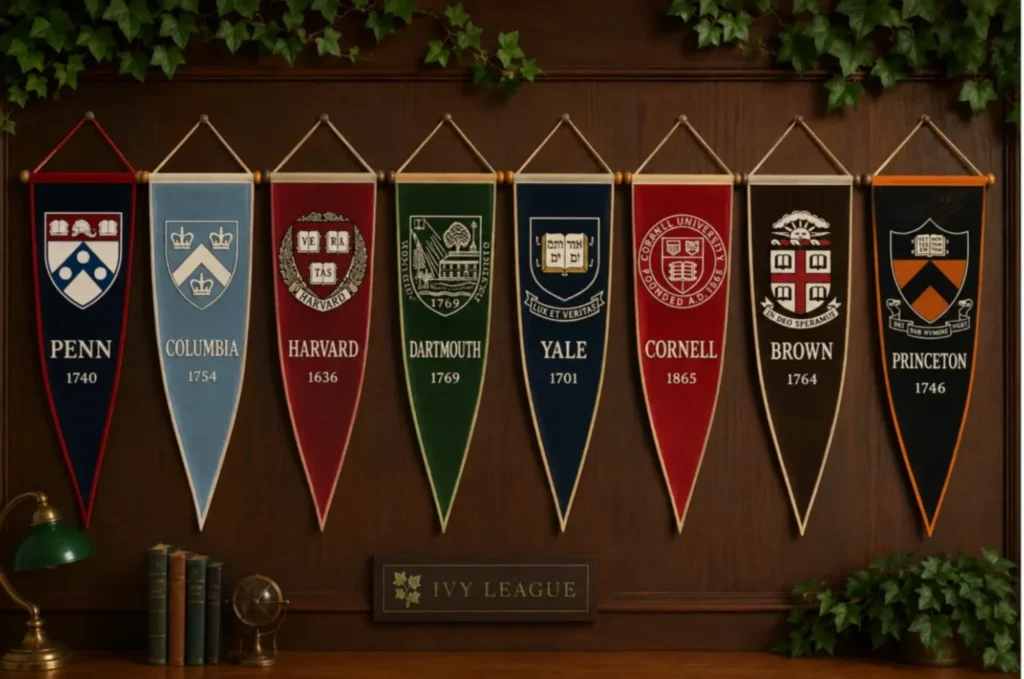
The other seven members are Brown, Cornell, Dartmouth, Harvard, Princeton, the University of Pennsylvania, and Yale.
Columbia is also one of the nation’s most selective universities, with an acceptance rate of about 4.2% for the Class of 2030.
Table of Contents
ToggleKey Takeaways
- Columbia is a founding Ivy League member, having participated in the original agreement establishing the conference in 1954.
- Its main campus in Manhattan’s Morningside Heights neighborhood provides access to New York City’s cultural, professional, and research opportunities.
- Columbia College and Columbia Engineering admitted approximately 4.2% of applicants for the Class of 2030, according to the latest reported class profile.
- Columbia College is known for its Core Curriculum, while Engineering and General Studies follow different undergraduate requirements.
- First-year applicants seeking fall 2027 enrollment may apply without SAT or ACT scores, but testing requirements will return for fall 2028 entry.
Is Columbia an Ivy League University?
Its membership dates to the original eight-school athletic agreement, rather than an academic ranking or later invitation.
The Ivy League began as an association of private Northeastern universities that shared athletic policies and educational standards. Although the name is now associated with selective enrollment and academic prestige, it remains an official athletic conference.
Columbia’s reputation extends beyond its membership. Founded in 1754, it is a private research institution with undergraduate programs, graduate and professional divisions, and academic resources throughout New York City.
How Columbia Joined the Ivy League
Columbia was among the eight institutions whose presidents signed the 1954 agreement extending shared athletic policies across intercollegiate sports.
Their relationship began earlier. The universities had competed in football for decades, and they signed an Ivy Group Agreement covering football in 1945.
Sportswriters were using the term Ivy League by the 1930s. According to the Ivy League’s official history, the agreement expanded to all intercollegiate sports in February 1954, and formal competition began during the 1956–57 academic year.
The conference has never added or removed a member.
Where Is Columbia University Located?
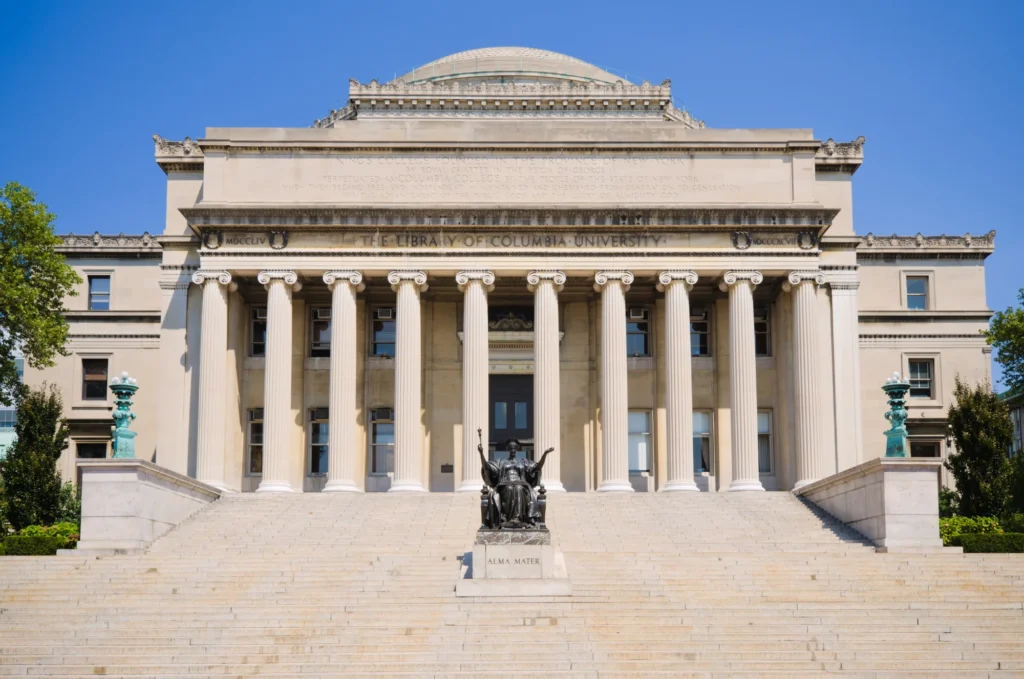
Columbia’s main campus is in Morningside Heights, on Manhattan’s Upper West Side in New York City.
It is one of two Ivy League institutions in New York State. The other is Cornell University, whose main campus is in Ithaca.
The setting creates a different undergraduate experience from campuses in smaller communities such as Hanover, New Hampshire, or Princeton, New Jersey.
Students can explore museums, attend performances, and pursue internships throughout the city. New York’s public transportation system also provides access to opportunities beyond the immediate campus.
What Is the Ivy League?
The Ivy League is an athletic conference composed of eight private universities in the northeastern United States.
It is often associated with academic achievement, influential alums, and competitive entry requirements. Still, membership is historical, not an academic award or ranking.
Other highly selective institutions, including Stanford, MIT, and Duke, are not members of the conference.
Each of the eight universities offers a different undergraduate environment, with differences in academic requirements, campus culture, location, and available programs.
List of Ivy League Schools in the US
There are eight Ivy League schools in the United States:
- Brown University, Providence, Rhode Island
- Columbia University, New York, New York
- Cornell University, Ithaca, New York
- Dartmouth College, Hanover, New Hampshire
- Harvard University, Cambridge, Massachusetts
- Princeton University, Princeton, New Jersey
- University of Pennsylvania, Philadelphia, Pennsylvania
- Yale University, New Haven, Connecticut
All eight are private institutions. Their shared membership does not mean they offer identical academic programs or student experiences.
How Does Columbia Compare to Other Ivy League Schools?
Columbia’s Manhattan location, undergraduate curriculum, and research opportunities set it apart from the others.
The following table compares the eight institutions using Class of 2029 acceptance rates, campus locations, and characteristics that may influence a student’s decision.
Ivy League School Comparison
| University | Location | Class of 2029 acceptance rate | Distinguishing feature |
|---|---|---|---|
| Brown | Providence, RI | 6.3% | Open Curriculum |
| Columbia | New York, NY | 4.9% | Core Curriculum and Manhattan location |
| Cornell | Ithaca, NY | 8.4% | Seven undergraduate colleges and schools |
| Dartmouth | Hanover, NH | 6.0% | Smaller undergraduate community |
| Harvard | Cambridge, MA | 4.2% | Extensive research and academic resources |
| Princeton | Princeton, NJ | 4.4% | Undergraduate focus and independent research |
| Penn | Philadelphia, PA | 4.9% | Liberal arts and preprofessional programs |
| Yale | New Haven, CT | 4.7% | Residential college system |
Sources: Columbia’s official Common Data Set.
Acceptance rates are only one measure of selectivity. They do not account for differences in applicant pools, admission priorities, or individual academic programs.
For a closer look at campus culture, academics, and student fit, see our side-by-side comparison of Ivy League schools.
Acceptance Rate and Selectivity
According to the Class of 2030 admissions analysis, citing Columbia’s updated August 2026 profile, Columbia College and Columbia Engineering received 61,031 applications and admitted 2,585 students.
That represents an acceptance rate of approximately 4.24%, compared with 4.94% for the Class of 2029.
Columbia’s official Class of 2029 profile reported 59,616 applications and 2,946 admits. Both figures reflect combined admissions to Columbia College and Columbia Engineering, not the School of General Studies.
The March 2026 announcement initially reported 2,581 admission offers for the Class of 2030. The later profile listed 2,585, so the updated figure is used here.
For a broader comparison, see Ivy League admission rates across all eight members.
Is Columbia the hardest Ivy to get into? Not according to the Class of 2029 data. Harvard and Princeton reported slightly lower overall acceptance rates that year.
Cornell had a higher rate of approximately 8.4% for the same class and is often described as the easiest Ivy to get into. Even so, an acceptance rate below 10% indicates substantial competition.
No student should interpret these percentages as a personal probability of admission. Academic preparation, the applicant pool, program selection, and institutional priorities all affect outcomes.
Location, Academics, and Prestige
Columbia’s Manhattan location provides access to employers, hospitals, museums, research centers, and cultural organizations across New York City.
Academically, Columbia College is especially known for its Core Curriculum, which includes shared study of literature, philosophy, history, music, art, and science.
The program traces its origins to Contemporary Civilization, introduced in 1919, and emphasizes discussion, close reading, and engagement with foundational texts.
Engineering undergraduates follow a different set of humanities and social science requirements alongside mathematics, science, and technical coursework.
Founded as King’s College in 1754, Columbia is New York State’s oldest institution of higher education.
Its broader academic community includes major research and professional programs in engineering, journalism, law, medicine, and international affairs.
Is Columbia as prestigious as Harvard? Both have established international academic reputations, although their strengths, programs, and student experiences differ.
Harvard has a larger endowment and extensive resources across its academic divisions. Columbia offers its own research strengths, a structured undergraduate liberal arts experience, and access to New York City’s professional and cultural resources.
Overall rankings can provide context, but students should also compare academic departments, teaching styles, financial aid, and campus environments.
Is Columbia College Ivy League?
Yes. Columbia College is an undergraduate division of Columbia University, an official Ivy League member. It is not a separate institution or a member of another conference.
Columbia has three undergraduate divisions:
- Columbia College: A liberal arts program built around the full Core Curriculum and a student’s chosen major.
- Columbia Engineering: Engineering and applied science programs that combine technical education with humanities and social science requirements.
- School of General Studies: A liberal arts undergraduate program designed for students with nontraditional educational paths, including those returning after an interruption in their studies.
The three divisions share resources within the broader university community, but their admissions processes, degree requirements, and financial aid arrangements differ.
Columbia College and Engineering use a shared undergraduate application process. General Studies has separate eligibility requirements and its own application.
How Much Does Columbia University Cost?
According to the official Columbia College tuition and fees schedule, tuition for the 2026–27 academic year is $72,800.
Its published estimated annual cost of attendance is $99,044 plus travel, before financial aid. This includes tuition, mandatory fees, average room and board, books, and personal expenses.
Students required to attend new-student orientation are charged an additional $625.
| Expense | Estimated annual cost |
|---|---|
| Tuition | $72,800 |
| Mandatory fees | $3,430 |
| Average room and board | $19,650 |
| Books and personal expenses | $3,164 |
| Total before travel | $99,044 |
| Travel | Varies |
Source: Columbia College Bulletin, 2026–27 Fees, Expenses, and Financial Aid . The figures apply to Columbia College and should not be assumed to represent every undergraduate division.
These published charges do not necessarily reflect what a family will pay after financial assistance.
Columbia College and Columbia Engineering provide need-based financial aid and state that they meet the full demonstrated financial need of admitted students under their policies.
For the Class of 2029, the average grants and scholarships received by students awarded institutional assistance totaled $77,908, according to the university’s published profile.
The School of General Studies has different financial aid arrangements and does not meet every student’s full demonstrated financial need.
Families comparing affordability across selective universities can review the cheapest Ivy League schools and learn how Ivy League tuition support and financial aid can affect the final cost.
How Do You Apply to Columbia University?
First-year students applying to Columbia College or Columbia Engineering can use the Common Application or the Coalition Application through Scoir.
Applicants select one of the two undergraduate divisions and may apply through binding Early Decision or nonbinding Regular Decision.
Under Early Decision, students generally agree to enroll if admitted, subject to Columbia’s published conditions and financial aid policies.
Regular Decision lets applicants consider offers from multiple institutions before committing to enroll.
Students comparing application plans can read How to Get Into the Ivy League for a broader explanation of academic expectations and preparation.
A typical first-year application includes:
- High school transcripts and academic records.
- Recommendations from teachers and a school counselor.
- Extracurricular activities and personal accomplishments.
- A personal essay and Columbia-specific supplemental responses.
- Standardized test scores when required by the applicable admission cycle.

Columbia’s SAT and ACT Requirements
For the 2026–27 application cycle, including students seeking fall 2027 entry, Columbia College and Columbia Engineering remain test-optional.
Applicants may submit SAT or ACT scores, but are not required to do so under that cycle’s policy.
Beginning with the 2027–28 application cycle, for students entering in fall 2028, the university will require SAT or ACT scores from first-year and transfer applicants.
Students who face qualifying challenges in meeting the requirement may request a waiver during the application process.
Columbia announced the return to required standardized testing on June 12, 2026, following a university review.
Students should verify the requirements for their intended entry year before submitting an application.
What Does Columbia Look for in Applicants?
Columbia reviews academic performance, course rigor, intellectual interests, extracurricular participation, recommendations, and personal qualities together.
The university does not determine admission using a single test result or GPA figure.
Academic preparation remains central to the review, including how well students have used the courses and opportunities available at their high schools.
Supplemental essays give applicants space to explain their academic interests and why the university’s programs and learning environment suit their goals.
A strong essay should identify genuine interests rather than rely on the institution’s reputation. Students can discuss specific courses, research opportunities, academic programs, or aspects of campus life that connect with their experiences.
For more detailed application guidance, see how to get into Columbia.
Applicants to the School of General Studies follow a separate process, with distinct eligibility requirements and application options.
CollegeCommit provides Ivy League admissions consulting for students preparing applications to Columbia and other selective universities. Its services include application timeline planning and supplemental essay guidance.
The firm works remotely with families across the United States. Students remain responsible for writing and submitting their own applications.
Frequently Asked Questions
Is Columbia University a Good School?
Yes. Columbia is widely regarded as a leading private research institution, with established academic programs in the humanities, sciences, engineering, journalism, law, and international affairs.
Its research resources and New York City location create opportunities for academic development, internships, and professional exploration.
Whether it is a good fit depends on a student’s academic interests, preferred campus setting, educational goals, and financial circumstances.
Families should consider whether Ivy League schools are worth it for their needs. Some students may find that a top non-Ivy League college offers a better match.
Is Yale or Columbia Harder to Get Into?
Both universities have highly competitive undergraduate admissions.
For the Class of 2029, Yale admitted approximately 4.7% of applicants, compared with Columbia’s 4.9%, according to their final published admission figures.
For the Class of 2030, Columbia’s updated profile reports a rate of approximately 4.2%. Yale’s fall 2026 first-year class profile reports approximately 4.4%.
Based on those later profiles, Columbia had the slightly lower reported rate for the Class of 2030. Both percentages are rounded, and the difference is small.
Historical acceptance rates do not establish an individual’s likelihood of admission. The strength of the applicant pool and the institution’s review criteria matter more for evaluating a particular application.
Related Articles


