



Membership and academic reputation differ, and that matters when families compare universities during the application process.
Table of Contents
ToggleKey Takeaways
- Johns Hopkins is not part of the Ivy League. The group has had eight members since the athletic conference formed in 1954, and JHU has never been added.
- The confusion comes from academics, not membership. JHU’s rankings and selectivity rival the Ivies, even though it belongs to a different category entirely.
- JHU is often grouped under the informal label Ivy Plus, alongside Stanford, MIT, and the University of Chicago. The term has no official governing body and simply describes universities outside the group with comparable selectivity and reputation.
- JHU’s overall acceptance rate has sat around 6 to 7 percent in recent years, according to its own Common Data Set. That places it in the same range as most of the eight members in overall selectivity.
- There is no indication JHU will ever become a member. The roster has never grown beyond the original eight, and claims to the contrary, including satirical articles, are not factual.
Is Johns Hopkins Part of the Ivy League
No. JHU is not a member of the Ivy League, and its academic standing has no bearing on that fact. Two separate criteria decide the matter: one is a fixed athletic conference roster, the other is a university’s research output and selectivity.
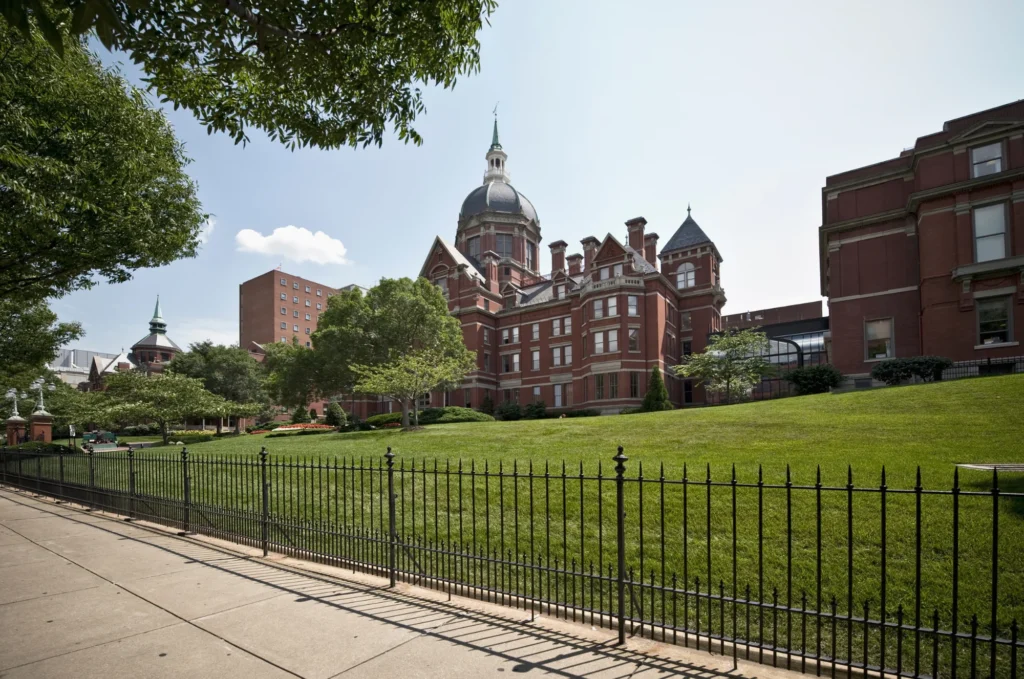
Johns Hopkins University is a private research university based in Baltimore, Maryland. So, is Johns Hopkins private? Yes, but private status has nothing to do with membership, since all eight members are private too.
JHU was founded in 1876 and is often called the first true research university in the United States. That model shaped how many other American universities run graduate study and research funding today.
What Defines the Ivy League
The Ivy League is an athletic conference of eight private universities in the Northeastern United States, not a ranking. The term originated in athletics, not academics. It named eight schools that competed in the same conference, and the Ivy League’s official history dates the conference to 1954. The eight Ivy League members are:
- Harvard University
- Yale University
- Princeton University
- Columbia University
- Brown University
- Dartmouth College
- Cornell University
- University of Pennsylvania
Over time, the term picked up a second meaning. People started using it as shorthand for elite, hard-to-enter universities in general.
The eight members built strong records over the years, with high test scores and strong job outcomes for graduates. Those scores even led some families to look up the average IQ of Ivy League students. The conference itself stayed the same size, but the term’s everyday meaning grew far beyond it.
That second meaning is why searches like Johns Hopkins University Ivy League return mixed results. Some pages answer the conference question. Others answer the “is this school elite” question. The same mix-up shows up in searches about whether Purdue is Ivy League, another highly ranked engineering school people assume belongs to the conference.
It shows up again in questions about whether Rice is Ivy League, a small, highly selective university that gets lumped in for similar reasons.
How Johns Hopkins Compares to the Ivy League
Membership aside, JHU holds its own against the Ivies on the things families care about most: rankings, research strength, and selectivity. These are the same factors families weigh when comparing Ivy League schools and building a list of target colleges.
Academic Rankings and Prestige
The Johns Hopkins University ranking has stayed in the top 10 among national universities in both recent U.S. News editions. In the 2027 edition of the U.S. News rankings, JHU placed ninth, ahead of Columbia, Dartmouth, Cornell, and Brown.
| University | Ivy League Member | 2027 Rank | 2026 Rank |
|---|---|---|---|
| Princeton University | Yes | 2 | 1 |
| Harvard University | Yes | 3 | 3 |
| Yale University | Yes | 4 | 4 |
| University of Pennsylvania | Yes | 7 | 7 |
| Johns Hopkins University | No | 9 | 7 |
| Columbia University | Yes | 12 | 15 |
| Dartmouth College | Yes | 12 | 13 |
| Cornell University | Yes | 14 | 12 |
| Brown University | Yes | 16 | 13 |
Source: U.S. News and World Report Best National Universities, 2027 edition, published September 2026.
So what is Johns Hopkins University known for? Research funding, strong programs in engineering and public health, and strong medical research.
The university’s undergraduate programs go well beyond its medical reputation. Its engineering program is among its best-known. Departments in the social sciences and international studies also attract students who want to conduct research alongside regular classes.
Faculty members in these departments often hold joint roles in JHU’s medical and public health divisions, so undergraduates gain access to research that many universities reserve for graduate students.
Families researching the Top 20 schools often find JHU listed alongside the eight members for this reason. What sets it apart from the Ivies is history, not academics.

Acceptance Rates and Selectivity
The Johns Hopkins University acceptance rate sits around 6 to 7 percent, according to the university’s Common Data Set. JHU’s acceptance rates have dropped over the past several years. That puts it in the same range as most published Ivy League admission rates.
Early Decision applicants see better odds than Regular Decision applicants. In the 2024-25 Common Data Set, 11.7 percent of Early Decision applicants were admitted, compared with 6.4 percent overall. That pattern is common at most highly selective private universities.
A single-digit rate also puts JHU below the easiest Ivy to get into, no matter its formal status. Families using the Common App should expect JHU’s own essay and supplement to match that same level of competition.
Is Johns Hopkins Considered an Ivy Plus School
Yes, though the label is informal. JHU is often grouped under Ivy Plus, placing it among the best non-Ivy League colleges with selectivity and reputation that rival the Ivies. The group usually includes Stanford, MIT, Duke University, the University of Chicago, the University of California, Berkeley, and JHU.
Ivy Plus is not an official title. No group or board keeps a formal list of who belongs. A few patterns show up again and again when people use the term:
- Strong faculty members and research funding across multiple disciplines
- Admission rates in the single digits
- Strong undergraduate programs in engineering and the social sciences
- A student body drawn from across the country and internationally, similar in scale and diversity to the classes at the eight members
- A reputation that extends well beyond the university’s home region
For families building a list of target colleges, the Ivy Plus label often matters more than the strict definition of the Ivy League.
How hard it is to get in looks similar to what you would find at the eight members. The conference name has little to do with the day-to-day experience of attending or applying, a comparison worth understanding when deciding whether Ivy League schools are worth the investment.
Selectivity, program strength, and campus fit matter far more than whether a university carries the Ivy name. A university outside the original eight can still offer the same level of rigor and research access that families link to the Ivies.
Frequently Asked Questions
Acceptance Rates and Selectivity
Johns Hopkins acceptance rates have dropped over the past several years. According to JHU’s Common Data Set, the overall rate has sat around 6 to 7 percent in recent admissions cycles. That puts JHU near, and some years below, several published Ivy League admission rates.
Early Decision applicants tend to see better odds than Regular Decision applicants, a pattern common at most highly selective private universities.
Students starting college research in high school benefit from knowing these numbers early. A single-digit acceptance rate puts JHU in the same range as most Ivy League schools, no matter its formal status, landing well below what you’d see at the easiest Ivy to get into. Families using the Common App should expect JHU’s own essay and supplement to match that same level of competition.
Is Johns Hopkins Considered an Ivy Plus School
Johns Hopkins is often grouped under the informal label Ivy Plus, placing it among the best non-Ivy League colleges that match or surpass the selectivity and reputation of the Ivy League. The group usually includes schools such as Stanford, MIT, Duke University, the University of Chicago, the University of California, Berkeley, and Johns Hopkins.
Ivy Plus is not an official title. No group or board keeps a formal list of who belongs. A few patterns show up again and again when people use the term:
- Strong faculty members and research funding across multiple disciplines
- Admission rates in the single digits
- Undergraduate programs in fields like engineering, social sciences, and international studies that rank among the strongest in the country
- A student body drawn from across the country and internationally, similar in scale and diversity to an Ivy League class
- A reputation that extends well beyond the university’s home region
For families building a college list, the Ivy Plus label often matters more than the strict definition of the Ivy League.
How hard it is to get in, how tough the classes are, and how graduating students fare afterward all look similar to what you’d find at an actual Ivy League school. The conference name has little to do with the day-to-day experience of attending or applying, a comparison worth understanding when deciding whether Ivy League schools are worth the investment.
Families who start college admissions research while a student is still in high school benefit from looking past labels early on. Acceptance rate, program strength, and campus fit matter far more than whether a school carries the Ivy League name.
A school outside the original eight can still offer the same level of rigor, research access, and job outcomes that families link to Ivy League schools.
Frequently Asked Questions

Is Johns Hopkins Considered an Ivy League School
No. People often ask whether JHU is an Ivy League school because its rankings and selectivity put it beside the Ivies, but the university has never belonged to the conference. Its acceptance rate sits close to several Ivies, though the hardest Ivy League to get into admits a smaller share of applicants.
Is Johns Hopkins Becoming an Ivy League School
No. There is no indication that JHU will join the conference. Hopkins is not an Ivy League school today, and membership has stayed fixed at eight since the conference formed. Some satirical articles published around April Fools’ Day have suggested otherwise, but these are not factual announcements and should not be treated as news.
Is Johns Hopkins Better Than NYU
It comes down to program and priority. In the 2027 U.S. News list, JHU placed ninth and NYU 31st. NYU counters with a larger student body, a well-regarded business school, and a spot right in Manhattan.
The better fit depends on your major, how big or small you want your campus to be, and how close you want to be to a major city.
At CollegeCommit, we work as an Ivy League admissions consultant with families sorting through exactly this kind of mix-up, where a school’s ranking does not match the label they expected. Knowing the difference between academic reputation and formal Ivy membership helps families build a more accurate list of target schools from the start.


